Deed classification is the most important decision you make in a title examination. It sets the search depth, the warranty exposure, the curative pathway, and the risk profile of the commitment. Every other examination step depends on getting it right.
The numbers behind this matter. ALTA’s 2022 Industry Data Call found that title professionals had to resolve issues in roughly 36% of all transactions before closing. Deed-level defects were among the most common drivers.
Deed fraud is a bigger problem now than it was a year ago. Losses hit $275.1M in 2025, up 59% year-over-year (FBI IC3, April 2026). Forgery and seller impersonation are no longer edge cases. Your examination protocol has to treat them as standard risk categories.
Table of Content
Every title examination begins with a deed.
Before you trace the ownership chain, clear the encumbrances, or issue a commitment, you need to know what kind of deed you are looking at. That single classification decision shapes everything that follows.
If the deed is a general warranty deed, you have a full search ahead of you. If it is a special warranty deed, the pre-grantor chain is entirely on your shoulders. If it is a trustee’s deed, the conveyance is meaningless without the foreclosure chain behind it.
Misidentify any of these, and the commitment you issue is built on the wrong foundation. According to ALTA’s 2022 Industry Data Call, title professionals had to resolve issues in roughly 36% of all transactions before closing. Most of those issues started with something the examiner could have caught at the deed.
This guide covers every major property deed type you will encounter. For each one you get the examination protocol that fits, the state-specific rules that affect how you handle it, the common defects to watch for, and the curative action to take when something is wrong. Five states get particular attention – California, Texas, New York, Florida, and Illinois. These are the jurisdictions where state-specific rules matter most.
The guide is written for people who do this work every day, including title examiners, operations managers, and underwriters, who already know what a deed is and want a working reference for everyday decisions.
A property deed is the legal instrument that transfers real estate ownership from one party to another. It conveys only whatever interest the grantor actually holds. That is why the examination behind the deed matters as much as the deed itself.
A deed is not proof of title in itself. It is evidence that a transfer happened. If the grantor held a clouded interest, the deed conveys exactly that clouded interest to the grantee. Your job as the examiner is to verify what the grantor actually had to give.
Every valid deed must contain certain core elements. If any are missing or defective, the deed may be legally unenforceable. A defect in any one element can cloud title and delay commitment.
See also:
U.S. property record types for a broader view of how deeds fit alongside other recorded instruments.
Anatomy of a Property Deed
Every deed should carry six core elements. Verify each one before you accept the deed as part of a clean chain.
Grantor and grantee
The grantor conveys the property interest. The grantee receives it. Both must be identified by full legal name. The grantor must have the legal capacity to convey, which means legal age, sound mind, and actual ownership of the interest being transferred.
If the grantor’s name in the current deed does not match the grantee’s name in the prior deed, you have a chain of title defect on your hands. Name discrepancies are one of the most common problems you will see. Always verify the names match precisely before closing the chain.
Legal description
The legal description identifies the property by its physical boundaries and its location in the public record. It is not the same as the street address. A street address can change. A legal description should not.
Three common formats appear in deeds – metes and bounds, lot and block, and government survey. An incomplete or incorrect legal description is one of the more serious deed defects you can encounter. It can mean the deed fails to convey the intended property at all.
Granting clause and habendum clause
The granting clause is the operative language of conveyance. The exact words vary by state – “grant, bargain, and sell” or “convey and warrant” are typical. The habendum clause is the “to have and to hold” language that defines the extent of the estate granted.
Together, these clauses define what is being conveyed and how. A missing or ambiguous granting clause can make a deed legally ineffective.
Consideration
Consideration is the value exchanged for the property. In an arm’s-length sale, this is the purchase price. In family transfers and corrective deeds, consideration is often nominal. You will see “one dollar” or “love and affection” on deeds where no real money changed hands.
Nominal consideration does not invalidate a deed. It is a flag worth noting, particularly on quitclaim deeds, where the absence of meaningful consideration can signal a non-arm’s-length transaction you should look into.
Notarization and witnessing
Notarization authenticates the grantor’s signature. It is required for recording in virtually every U.S. jurisdiction. Witnessing requirements vary by state.
Florida requires two witnesses on every deed, in addition to notarization. Most other states require notarization only. A defective notarization block (missing seal, incorrect date, absent notary) may make the deed unrecordable or legally challengeable.
Delivery and acceptance
A deed is not legally effective until the grantor delivers it and the grantee accepts it. Recording creates a rebuttable presumption of delivery, but it does not replace actual delivery.
This rarely matters in standard transactions. In estate conveyances and family transfers, it can become relevant when the grantor’s intent is in dispute.
Run through the six elements on every deed you handle. Most deeds will clear all six in under a minute. The ones that do not are the deeds that turn into curative work later. Catching the gap at the deed stage is always cheaper than catching it at commitment.
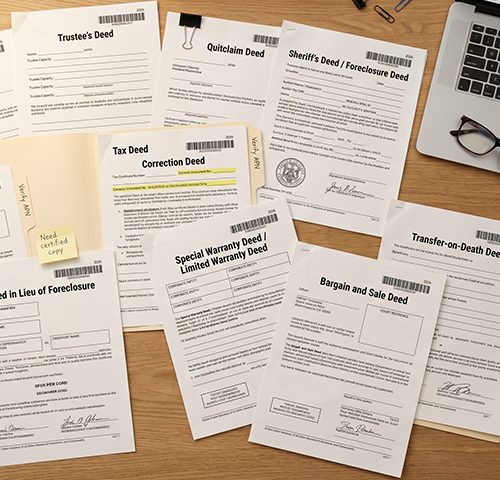
Eight property deed types are in active use across U.S. jurisdictions today such as general warranty deed, special warranty deed, quitclaim deed, grant deed, bargain and sale deed, trustee’s deed, sheriff’s deed, and executor’s deed. Each one conveys ownership. Each one carries a different warranty level. Each one requires a different examination depth from you.
Deed type is the first determination you make on any file. It sets the search depth. It defines the warranty exposure. It signals what additional documentation the chain will need.
36%
of transactions had title issues that had to be resolved before closing. Deed-level defects were among the most common drivers.
Related reference:
AI document classification for property deeds and title instruments.
The profiles below cover each deed type from your standpoint as the examiner. Not just what the deed is, but what it means for the work in front of you.
Deed Types Comparison Matrix
| Deed Type | Warranty Level | Coverage | Typical Use | Risk |
|---|---|---|---|---|
| General Warranty Deed | FULL | All defects – all time | Residential sale | LOW |
| Special Warranty Deed | LIMITED | Grantor’s period only | Commercial, REO, estate | MEDIUM |
| Quitclaim Deed | NONE | No warranty | Family, curative, divorce | HIGH |
| Grant Deed (CA/NV) | IMPLIED | Grantor’s acts only | CA residential sale | MEDIUM |
| Bargain & Sale Deed | NONE | No warranty | Foreclosure, tax sale | HIGH |
| Trustee’s Deed | NONE | Requires full forec. chain | Non-judicial foreclosure | HIGH |
| Sheriff’s / Executor’s | NONE | Requires court documentation | Judicial forec., probate | HIGH |
The general warranty deed is the broadest conveyance instrument in U.S. real estate. The grantor warrants title against all defects, not just defects that arose during their ownership. The warranty reaches back to the origin of title.
This is the most common deed type in standard residential arm’s-length transactions. The grantor has accepted the maximum legal obligation for title quality.
That does not mean you can relax. The title chain behind the deed has to support that warranty. A full search is still required. Catching defects before closing is your job, regardless of what the deed warrants.
Examination protocol. Apply full search depth. Verify continuity of ownership from prior deeds. Confirm all encumbrances are identified and addressed. A general warranty deed does not reduce your workload. It is the baseline against which the chain is measured.
The special warranty deed limits the grantor’s warranty to defects that arose during their period of ownership only. The grantor makes no representations about what happened before they acquired the property.
You will see special warranty deeds most often in commercial transactions, REO sales, and estate conveyances. The grantor’s limited warranty means pre-grantor defects are not covered. The full responsibility for identifying anything that predates the current grantor’s ownership sits with you.
Examination protocol. Do not rely on the grantor’s warranty for any period before their acquisition. Research the full ownership chain independently. Pay particular attention to encumbrances that may predate the grantor’s acquisition date. Those are the defects most likely to be present and undisclosed.
The quitclaim deed conveys whatever interest the grantor holds. Nothing more, nothing less. No warranty of any kind. If the grantor holds no interest at all, the deed conveys nothing.
The deed itself will not tell you which situation you are in. You will find quitclaim deeds most often in family transfers, divorce settlements, corrections of prior recording errors, and cloud-on-title clearance work.
A quitclaim from a prior grantee whose name was misspelled is routine curative work. A quitclaim in the middle of an arm’s-length ownership chain is a different matter entirely. The first is routine. The second needs investigation.
Examination protocol. Never assume clean title from a quitclaim deed alone. Verify independently that the grantor actually held the interest being conveyed. Research the full chain through and beyond the quitclaim. If the quitclaim is being used as a curative instrument, confirm it addresses the specific defect it is intended to correct.
Use Case: A Quitclaim in an Active Chain
Consider a mid-sized title company processing a current owner search on a residential property in Cook County, Illinois. The chain shows a standard warranty deed conveyance in 2018, followed by a quitclaim deed in 2020. The 2020 quitclaim is from a grantor with a different last name than the prior grantee, with $1 in consideration and no supporting documentation on record. No divorce filing. No estate. No trust instrument.
The examiner flags the 2020 quitclaim as an unresolved chain break. Further research turns up a marriage certificate at the county clerk. The grantor and the prior grantee are the same person. A corrective affidavit of identity bridges the gap before commitment is issued. Without that investigation, the chain would have been cleared with a structural defect still in place.
The grant deed is the dominant conveyance instrument in California and several other western states. It provides implied warranties, not express warranties. The grantor warrants that they have not previously conveyed to another party, and that the property is free from undisclosed encumbrances the grantor created.
You will find this is where examiners working outside California often go wrong. Grant deeds get misclassified as warranty deeds. The functional purpose is similar. The warranty coverage is narrower. Apply full search depth, but remember that the implied warranty covers only the grantor’s own acts.
Examination protocol. Apply full search depth. Note that the implied warranty covers only the grantor’s own period and actions. Confirm the documentary transfer tax disclosure is present on every California grant deed. Its absence can flag a recording issue you need to follow up on.
The bargain and sale deed conveys property with no warranty of title. You will see this deed most often in foreclosure sales, tax deed sales, and sheriff’s sales. The conveying party in these situations has limited knowledge of the title history, which is why no warranty is given.
A bargain and sale deed in the chain frequently signals a gap you need to look into. For tax deeds, verify the sale process was followed correctly, proper notice was given, and the redemption period has expired. Defects in the tax sale process can cloud title even after recording.
Examination protocol. Treat the bargain and sale deed as a gap indicator. Research the circumstances of the conveyance fully. For tax deeds, verify the tax sale process and confirm the redemption period has expired. For foreclosure-related bargain and sale deeds, confirm the foreclosure sequence is complete and properly recorded.
A trustee’s deed is issued after a non-judicial foreclosure sale completes. Here is how the chain works. Under a deed of trust, the borrower originally conveyed nominal title to a trustee as security for the lender. When the borrower defaults and the foreclosure process complete, the trustee issues a trustee’s deed to the successful bidder at the foreclosure sale.
A trustee’s deed without the foreclosure documentation behind it is incomplete. Your examination has to verify the full sequence. The deed of trust on record. The notice of default was recorded and served. The notice of trustee’s sale recorded and published. Statutory waiting periods observed. Trustee authority confirmed in the original deed of trust.
Examination protocol. Verify trustee authority in the original deed of trust. Confirm the notice of default, the statutory waiting period, and the notice of trustee’s sale are all on record and properly executed. A trustee’s deed is the end of a documented legal process. The chain has to show that process was followed.
A sheriff’s deed conveys property after a court-ordered foreclosure sale in a judicial foreclosure state. It is the product of court proceedings. Your examination has to confirm the underlying court action, the judgment, and the proper conduct of the sheriff’s sale.
An executor’s deed conveys property from a decedent’s estate as part of the probate process. The executor’s authority comes from their court appointment. You need to verify the letters testamentary, court jurisdiction over the property, and any court order authorizing the sale.
Examination protocol. Neither a sheriff’s deed nor an executor’s deed stands alone in the chain. Obtain and review the underlying court documentation. For sheriff’s deeds, confirm the judgment, the sale process, and the right of redemption period. For executor’s deeds, confirm probate jurisdiction, executor authority, and court authorization where required.
| Deed type | Warranty level | Common use | Examination depth |
|---|---|---|---|
| General warranty deed | Full. All defects, all time. | Standard residential sale | Full search required |
| Special warranty deed | Limited. Grantor’s period only. | Commercial, REO, estate | Full search; pre-grantor chain on examiner |
| Quitclaim deed | None | Family transfer, curative, divorce | Independent ownership verification |
| Grant deed | Implied. Grantor’s acts only. | California residential sale | Full search; warranty narrower than it appears |
| Bargain and sale deed | None | Foreclosure, tax sale | Gap indicator; research circumstances fully |
| Trustee’s deed | None | Non-judicial foreclosure completion | Verify full foreclosure sequence on record |
| Sheriff’s deed | None | Judicial foreclosure completion | Confirm court action, judgment, sale process |
| Executor’s deed | None | Probate / estate conveyance | Verify probate jurisdiction and executor authority |
Flag the deed type at order entry, not at retrieval. For trustee’s deeds, bargain and sale deeds, and sheriff’s deeds, send out requests for supporting documentation the same day the order opens. Waiting until retrieval to find a missing foreclosure sequence adds days to files where the delay was avoidable from the start.
Related reference:
See how deed types fit within the broader property record landscape across all instrument categories.
What is the difference between a mortgage and a deed of trust?
A mortgage is a two-party instrument. The borrower pledges the property as collateral to the lender and keeps title. If the borrower defaults, the lender has to go to court to foreclose.
A deed of trust is a three-party instrument. The borrower conveys nominal title to a neutral trustee, who holds it as security for the lender. Default lets the trustee conduct a non-judicial foreclosure. That is a faster process with a different documentary chain behind it.
The security instrument type decides what foreclosure chain documentation you have to verify. Which one applies in your file depends on the state. Some states use only mortgages. Some use only deeds of trust. A few use both.
The distinction matters to every title professional who works across state lines. The security instrument decides what the foreclosure chain looks like, what the lien release instrument is called, and what documentation your examination has to verify before commitment.
A mortgage is two parties. Borrower and lender. The borrower retains title. If they default, the lender files a foreclosure action in court. The court oversees the process. Eventually a sheriff’s deed conveys the property at sale.
The deed of trust is three parties. Borrower, lender, and trustee. The borrower conveys title to the trustee, who holds it as security. If the borrower defaults, the trustee can foreclose without going to court. The process is faster. The conveyance instrument at the end is a trustee’s deed.
This distinction drives everything that follows in your examination.
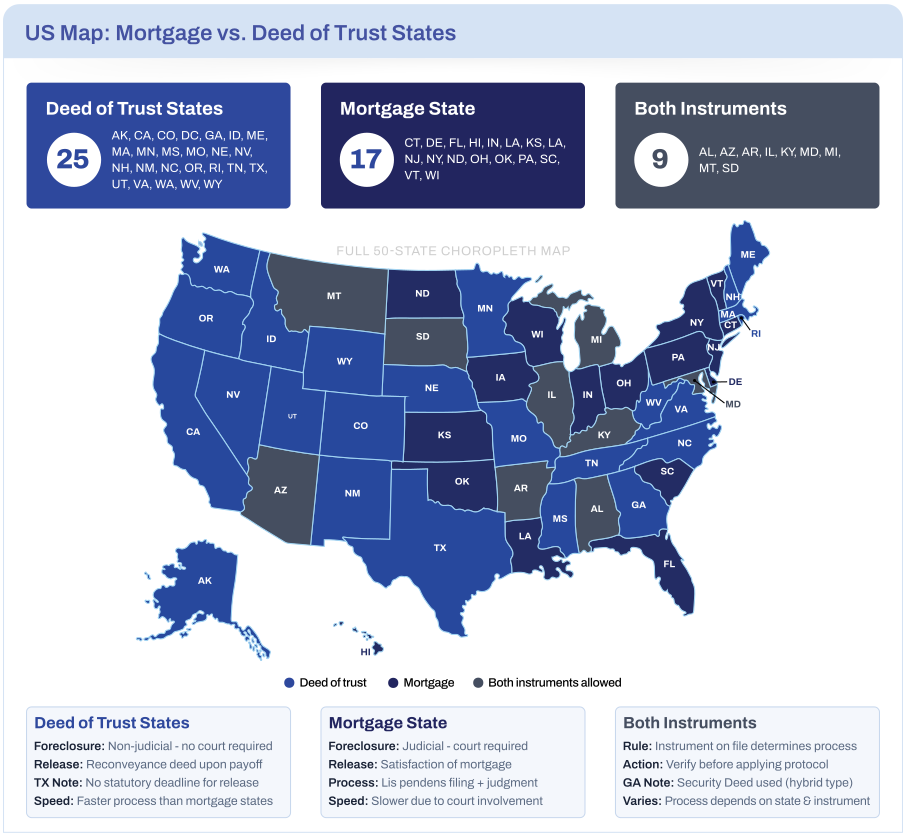
| Security instrument | What it means for your work |
|---|---|
| Mortgage state (e.g. New York, Florida, Illinois) | Foreclosure produces a lis pendens, a judgment, and a sheriff’s deed. The release instrument is a satisfaction of mortgage. Look for all three stages when you examine a property with prior mortgage history. |
| Deed of trust state (e.g. California, Texas, Arizona) | Foreclosure produces a notice of default, a notice of trustee’s sale, and a trustee’s deed. The release instrument is a reconveyance deed. An unreleased deed of trust is one of the most common title defects you will see in these states. |
| States using both (e.g. Georgia, North Carolina) | The instrument type decides the foreclosure chain. Georgia uses a security deed, which is a hybrid instrument that conveys title to the lender directly. Verify the instrument type before you apply any examination protocol. |
Whether you are in a mortgage state or a deed of trust state, unreleased security instruments are among the most common title defects you will encounter. A mortgage that was paid off but never formally satisfied is still a lien of record.
The examination protocol is the same in either case. Identify every security instrument recorded against the property. Confirm each one has a corresponding release. Verify the release was recorded before the next conveyance.
Found this useful? Share it with your team or save it for your next examination cycle.
How to use this in examination: Verify the security instrument type first
Confirm the security instrument type before you apply any examination protocol. Deed of trust or mortgage. In deed of trust states, every open deed of trust on record must have a corresponding reconveyance. In mortgage states, every open mortgage must have a recorded satisfaction. An unreleased instrument from any year is a lien of record until it is released.
Deed type sets the search depth, the warranty assumptions, and the supporting documentation requirements for every link in the chain. A chain of general warranty deeds requires full search verification at each conveyance. A special warranty or quitclaim deed shifts responsibility for pre-grantor history entirely to you. Court-ordered deeds (trustee’s, sheriff’s, executor’s) need supporting documentation on record before the chain is complete.
Chain of title is the sequential record of every instrument affecting ownership of a property, from the earliest recorded conveyance to the present day.
Your job is to construct that chain, verify its integrity, and identify gaps, defects, and encumbrances. Deed type is the lens through which you assess every link in that chain.
A chain of general warranty deeds tells you that each grantor accepted full responsibility for the title they conveyed. You still apply full search depth, but the warranty chain gives you a layer of legal assurance behind every conveyance.
When the chain includes special warranty or quitclaim deeds, your responsibility deepens. Each limited or no-warranty conveyance means pre-grantor history was never warranted. You have to verify it independently. That is true even if the rest of the chain looks clean.
A quitclaim deed is not automatically a red flag. Plenty of legitimate transactions use them. Corrective deeds. Transfers into or out of living trusts. Spousal transfers at divorce. Releases from potential heirs.
The question to ask about any quitclaim in the chain is simple. What was the purpose, and does the rest of the chain support it? A documented divorce quitclaim is routine. An unexplained quitclaim from an unidentified third party needs investigation before you close the chain.
The judgment work behind these calls is what separates a good examination from an automated one. Kathy Kwak, COO of Proper Title LLC, put it directly:
Court-ordered conveyances and foreclosure conveyances do not stand alone in the chain. Each one needs a set of supporting instruments to establish that the conveyance was legally valid. Without those supporting instruments, the chain has a structural gap, regardless of whether the deed itself was properly recorded.
| Deed type | What completes the chain |
|---|---|
| Trustee’s deed (non-judicial foreclosure) | Original deed of trust, notice of default, notice of trustee’s sale, evidence of proper publication, and the trustee’s deed to the successful bidder |
| Sheriff’s deed (judicial foreclosure) | Original mortgage, lis pendens, foreclosure judgment, order of sale, evidence of sheriff’s sale, and the sheriff’s deed |
| Executor’s deed (probate) | Letters testamentary or letters of administration, confirmation of probate court jurisdiction, court order authorizing the sale (if applicable), and the executor’s deed |
| Tax deed | Delinquent tax record, proper notice to the prior owner, redemption period expiration, and the tax deed |
Chain of Title:Clean Chain vs. Chain with Gaps
How title is vested on the deed (the legal form of ownership) decides how the property passes on death, divorce, or voluntary transfer. Vesting errors in the chain are a common source of title defects, because they affect whether the right party has authority to convey in the next conveyance.
| Vesting form | What you need to verify |
|---|---|
| Joint tenancy (with right of survivorship) | On the death of one joint tenant, the surviving tenant takes by operation of law. No probate is required, but an affidavit of survivorship should be on record. Verify it was recorded before the next conveyance. |
| Tenancy in common | Each co-tenant holds a separate, transferable share. All co-tenants must join in any conveyance of the full property. Verify every co-tenant’s interest is accounted for in the chain. |
| Community property (AZ, CA, ID, LA, NV, NM, TX, WA, WI) | Both spouses hold equal interests. Both must join in any conveyance. A deed signed by one spouse alone does not convey the community interest. Always examine for spousal consent on every deed in a community property state. |
| Sole ownership (individual) | Straightforward conveyance, but verify marital status if the property is in a community property state. A married individual who purports to convey as sole owner in one of those states may need spousal joinder. |
| Trust (as grantee) | Verify the trust exists, has not been revoked, and the trustee named in the deed has authority to hold and convey title. A deed to a trust without a named trustee may be defective. |
How to use this in practice: match search depth to warranty level and deed type
For every quitclaim deed in the chain, document the purpose, verify the grantor’s actual interest, and research fully through and beyond the quitclaim. For trustee’s deeds and sheriff’s deeds, request the supporting documentation immediately. For vesting changes (survivorship, community property, trust), confirm the transfer instrument was recorded before the next conveyance.
Property deed recording requirements vary across three dimensions. These include the type of security instrument used (mortgage vs. deed of trust), state-specific execution rules like Florida’s two-witness requirement and California’s documentary transfer tax disclosure, and county-level format and indexing variations. These are structural differences that apply on every file in those jurisdictions, not edge cases. If you examine across state lines, you have to apply state-specific protocols consistently.
Recording a deed establishes constructive notice. It puts the world on notice that the conveyance occurred. How that recording works varies a lot from state to state, and sometimes from county to county within the same state.
Those variations have direct implications for your examination work. Knowing which recording act applies in the jurisdiction you are working in, and knowing what the local format requires, is essential before you can assess priority or completeness.
U.S. states fall into three recording act categories. The category your state belongs to decides who prevails in a dispute between competing claimants to the same property.
| Recording act type | Recording act type The rule | Key states |
|---|---|---|
| Race-notice (most common) | A subsequent purchaser prevails if they recorded first AND had no notice of the prior conveyance at the time of purchase. | California, New York, Texas, Florida (majority of states) |
| Notice | A subsequent purchaser prevails if they had no notice of the prior conveyance at time of purchase, regardless of who records first. | Iowa, Louisiana, North Carolina, Kansas |
| Race (rare) | First to record prevails, regardless of notice. | North Carolina (for some instruments), Louisiana |
For your examination, the recording act type decides the priority questions you have to answer. In race-notice states, your job is to identify any prior unrecorded conveyances that a bona fide purchaser could have encountered. In notice states, actual or constructive notice of any prior interest affects priority regardless of recording date.
The five states below cover the bulk of cross-state title examination volume in the U.S. Each one has distinctive rules you have to apply consistently if you want clean commitments on every file.
Recording Requirements:5-State Comparison
California uses grant deeds as the standard residential conveyance instrument. Documentary transfer tax is required at recording and has to be disclosed on the deed or on a separate attachment.
California is a deed of trust state. The release instrument after payoff is a reconveyance deed, not a satisfaction of mortgage. Unreleased deeds of trust are among the most common defects you will find in California title searches.
California watch point. Verify documentary transfer tax disclosure on every grant deed. Confirm every deed of trust on record has a corresponding recorded reconveyance. The 30-day reconveyance requirement under California Civil Code § 2941 is on the books, but lender compliance is uneven. Do not assume.
Texas uses deeds of trust as its primary security instrument. One distinctive feature you will see only in Texas is the vendor’s lien deed, used in seller-financed transactions. The seller keeps a lien on the property until the purchase price is fully paid.
Texas has no statutory deadline that requires lenders to record a release after payoff. That makes unreleased vendor’s liens and deeds of trust among the most common defects you will encounter in Texas title work. Some of these instruments are decades old.
Texas watch point. No statutory release deadline means unreleased security instruments can be very old. Research every open deed of trust and vendor’s lien on record. Confirm payoff through recorded release instruments. Do not infer it from the passage of time.
New York is a mortgage state with judicial foreclosure. The release instrument after payoff is a satisfaction (or discharge) of mortgage. New York City uses the ACRIS system, which is a digital recording platform with field naming conventions that do not match national standards.
New York requires a transfer tax form (RP-5217) at recording for most conveyances. Whether it is present or absent is a useful data point when you are evaluating whether a transaction was arm’s-length.
New York watch point. Verify satisfaction of mortgage for every open mortgage on record. In NYC, use ACRIS directly but verify field naming conventions before you trust the index. Confirm RP-5217 filing on every conveyance.
Florida is a mortgage state with judicial foreclosure. The distinctive rule here is the two-witness requirement under Florida Statute § 695.26. Deeds must be signed in the presence of two witnesses, in addition to notarization. A Florida deed with only one witness may be legally defective.
Florida also imposes documentary stamp taxes on deeds. The tax is calculated on the consideration and appears on the recorded instrument. If the stamp tax amount looks inconsistent with the stated consideration, that is worth investigating.
Florida watch point. Verify the two-witness requirement on every Florida deed. Confirm documentary stamp tax is present and consistent with stated consideration. For foreclosure chains, verify the lis pendens and judgment are on record before you accept a sheriff’s deed.
Illinois is a mortgage state with judicial foreclosure. Transfer tax requirements vary by county. Cook County uses a document type coding system that does not always align with standard instrument name conventions.
Do not rely on the Cook County index label to identify an instrument type. Verify from the document itself. Illinois also uses plat of survey requirements in many transactions, particularly in Chicago and the collar counties.
Illinois watch point. Verify Cook County instrument type from the document content, not from the index code. Confirm the transfer tax stamp is present and in the correct county-specific format. Cross-reference lot and block legal descriptions against the recorded plat.
Keep a standing reference for every state in your regular order volume. For each one, you need to know what security instrument is standard, what the release instrument is called, what local execution requirements apply (witnesses, transfer tax disclosure), and what the county indexing system requires you to verify the instrument type from. The watch points in this section are the most common examination failures in each state.
For the full 50-state reference, see Appendix B at the end of this guide.
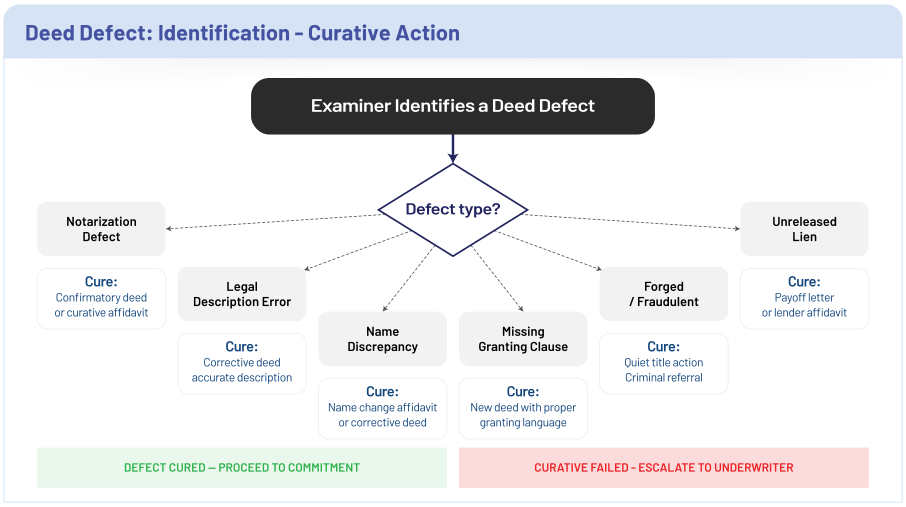
The most common deed defects you will encounter during title examination are grantor and grantee name discrepancies across the chain, missing or defective notarization, incorrect or incomplete legal descriptions, unreleased security instruments with no recorded satisfaction or reconveyance, and capacity defects where the grantor lacked authority to convey.
Each one needs curative action before a clean commitment can be issued. Each one is more manageable when you catch it at intake than at retrieval.
Deed defects range from small technical irregularities you can cure in a day to substantive problems that require significant legal action. Catching them early, before commitment, is the difference between a manageable curative process and a post-closing claim.
This section covers the eight common categories of defects you will see in production work, what the examination flag looks like for each, and the typical curative action that resolves it.
A deed that was not properly notarized may be legally unrecordable or challengeable. Common notarization defects you will see include a missing notary seal, an expired commission at the time of signing, a notary who was not actually present at execution, or a notary who was also a party to the transaction.
Recording a defectively notarized deed does not cure it. The curative action typically requires a confirmatory deed or a curative affidavit from a qualified witness.
An incorrect legal description is one of the more serious defects you can find. It can mean the deed fails to convey the intended property at all. Common problems include transposed lot and block numbers, wrong subdivision names, and truncated metes and bounds descriptions.
Verify every legal description against the assessor’s parcel record and against the recorded plat where one exists. A mismatch needs a corrective deed before you can clear the chain.
The grantor in a deed must match the grantee in the immediately prior deed. A mismatch (spelling variation, nickname, missing middle initial, name change after marriage or divorce) breaks the chain of title.
You bridge the gap with a recorded instrument. A name change affidavit. A corrective deed. Court documentation. Whatever the underlying cause, it has to be on the record. Do not assume two names refer to the same person without documented evidence.
Use Case: A Name Discrepancy Causing Commitment Delay
Consider a Texas title company processing a refinance search on a property in Harris County. The current deed of trust names the borrower as “Robert J. Williamson.” The prior warranty deed in the chain names the grantee as “Bob Williamson.” The deed before that names the grantee as “Robert Williamson Jr.”
Three name variations across three instruments. None of them match precisely. The lender’s underwriter requires a chain of title affidavit confirming all three names refer to the same individual before the refinance can close. What should have been a routine search becomes a two-day curative exercise. Name consistency across the chain, verified at examination and flagged early, prevents this outcome.
A deed without a clear granting clause may not be legally effective as a conveyance. This is rare in modern deeds. You may still see it in older instruments and in self-prepared deeds.
An ambiguous habendum clause that limits the estate to something less than fee simple (a life estate, for example) has significant implications for the current owner’s ability to convey. Watch for this in estate-related chains.
$275.1M
in real estate fraud losses in 2025. Up 59% year-over-year.
Deed fraud is not an edge case anymore. Real estate fraud losses jumped from $173 million in 2024 to $275.1 million in 2025, driven by 12,368 complaints to the FBI (FBI IC3, 2025 Internet Crime Report, April 2026).
ALTA data puts the average fraud and forgery claim above $143,000. In 2023, 28% of title companies reported at least one seller impersonation attempt (ALTA / Inman, November 2025). Deed fraud is now a systematic scheme, not an occasional incident.
$143,000+
average cost of a fraud and forgery title claim.
The cost of these claims has changed how the industry talks about the value of professional title work. Diane Tomb, then-CEO of ALTA, framed it this way when the $143,000 average claim figure was first released.
Common fraud patterns you will see include deeds purportedly signed by deceased grantors, instruments from non-existent trust trustees, and forged signatures on otherwise legitimate-looking documents.
Your verification steps for a suspected fraud should include cross-referencing the grantor’s signature against prior recorded instruments, confirming the grantor was alive and legally capable on the signing date, and verifying the notary’s seal, commission status, and physical presence at execution.
The industry’s framing of the problem has shifted. Chris Morton, current ALTA CEO, has emphasized the operational dimension:
A deed executed by a minor, a person under guardianship, or someone lacking mental capacity at signing is voidable. In some cases, it is void outright. Capacity defects are most likely to appear in estate-related transactions and in older instruments.
Where capacity is in question, supporting documentation should be on record. The power of attorney. A guardianship order. A court authorization confirming the conveying party had authority to act. If none of those is on record, you have curative work to do.
A significant gap between the execution date and the recording date is worth investigating. Gaps of weeks or months are common and usually benign.
A deed recorded years after execution may indicate it was held back intentionally, possibly to allow other interests to attach during the gap period. In race-notice states, unrecorded instruments during a gap period can affect your priority analysis for any interests that are attached in between.
| Defect type | Examination flag | Typical curative action |
|---|---|---|
| Defective notarization | Missing seal, expired commission, notary absent at signing | Confirmatory deed or curative affidavit from qualified witness |
| Incorrect legal description | Mismatch with assessor record or recorded plat | Corrective deed recording the accurate legal description |
| Name discrepancy in chain | Grantor name does not match prior grantee name | Name change affidavit, corrective deed, or court documentation |
| Missing granting clause | No operative conveyance language present | New deed from grantor with proper granting language |
| Forged or fraudulent deed | Deceased grantor, non-existent trust, signature inconsistency | Quiet title action; criminal referral where appropriate |
| Capacity defect | Minor, guardian, or mentally incapacitated grantor | Court authorization; guardianship approval; confirmation by legal representative |
| Extended recording gap | Execution-recording gap of more than 12 months | Investigate intervening interests; may require curative affidavit or title indemnity |
| Unreleased security instrument | Mortgage or deed of trust with no recorded release | Payoff letter, indemnity from lender, or affidavit of lost instrument |
Run a defect pre-screen at order entry. Flag name discrepancy risk by comparing the current owner name in the order against the assessor record. For Texas files, screen for open deeds of trust regardless of age. For Florida files, confirm the two-witness requirement awareness before retrieval begins. The work is the same in either case. The difference is timing. Move curative identification from the examination stage to the intake stage, and you compress the delay by a full retrieval cycle.
AI platforms pre-trained on deed types and county formats can now classify the deed type, flag potential defects, and structure ownership and encumbrance data before you begin review. This compresses the preparation stage by 25% to 40% on standard files. The split is clear; AI handles the classification and the flagging. You handle the legal judgment calls that curative work requires. This is the current state at early adopting title companies, not a future direction.
The examination protocols throughout this guide are judgment-intensive work. Correctly identifying a deed type. Tracing a chain of title through complex conveyances. Spotting defects before they become claims. All of it requires pattern recognition you built up over years of practice.
AI-assisted classification is changing where that pattern recognition starts. Platforms pre-trained on 150+ real estate document types now classify the deed type, flag potential defects, and structure ownership and encumbrance data before you begin your review.
A March 2026 ALTA study confirms the direction. AI tools handle record search and organization work. The value in title insurance still sits in human judgment and problem-solving during curative work (ALTA, Measuring the Complexity of Title Production, 2026).
The strategic implication is broader than any single technology. Nate Baker, CEO and Co-Founder of Qualia, summarized it directly in Qualia’s 2025 State of AI in Title and Escrow report:
Customer result:
See how a leading U.S. title insurer increased analyst productivity by 30% while accelerating title-search preparation. Read the customer story →
For operations managers, the productivity impact is already measurable. AI-assisted extraction combined with human validation has delivered 30% analyst productivity gains, cut 8-hour title search orders to under 5 hours, and maintained 100% accuracy through the same period.
The split between AI work and examiner work stays clear. AI can classify and flag. AI cannot make the legal judgment calls. A trustee’s deed with a procedural irregularity. An unexplained quitclaim. A chain gap with no recorded explanation. These remain examiner territory.
Related feature:
What AI removes is the time you spend on work that does not require your judgment. What that gives back is more of your working day for the work that does.
Reduce the preparation work before title examination
Hitech i2i identifies and classifies relevant instruments, extracts key deed and title data, validates structured outputs, and organizes source-linked evidence for professional examination.
Explore AI Title Search PreparationThe protocols in this guide point to four changes that reliably improve your examination accuracy and reduce commitment delays across every file type and deed category.
The most recoverable examination delay is the one caused by identifying a deed type problem mid-file. A trustee’s deed needs the foreclosure sequence documentation. An executor’s deed needs the probate records. A quitclaim in an arm’s-length chain needs independent ownership verification.
Each of these is manageable at intake. Each one becomes a delay when you discover it at retrieval. Build deed type classification into your pre-order checklist so the right documentation requests go out on day one.
Generic examination protocols produce systematic errors when you apply them across state lines. Keep a reference, or build one from Section 5 of this guide, that maps each state’s security instrument type, its release requirement, its foreclosure method, and its key recording watch points.
For Texas, screen for unreleased deeds of trust and vendor’s liens regardless of age. For Florida, confirm the two-witness requirement on every deed before you accept it. For Cook County, verify the instrument type from the document content, not from the index code. These are not edge cases. They are the most common defects you will find in each jurisdiction.
ALTA’s 2026 study put it plainly. Standard transactions average 22 hours to close. Difficult transactions average 45 hours. That 23-hour gap is driven mostly by defects you find too late in the file (ALTA, Measuring the Complexity of Title Production, March 2026).
Run name discrepancy pre-screens at intake. Flag open security instruments before retrieval starts. Identify prior foreclosure chains, estate conveyances, and quitclaim patterns at the order entry stage. The identification stage is where your process improvement actually operates. The resolution stage (curative affidavits, lender releases, probate court filings) is set by third parties and cannot be compressed.
Title companies that have adopted AI-assisted document preparation are already operating at measurably higher throughput. One of the top four U.S. title insurance underwriters using Hitech i2i achieved a 30% increase in analyst productivity, cut 8-hour title search orders to under 5 hours, and maintained 100% accuracy through AI-assisted extraction combined with human validation.
This pattern matches what working practitioners across the industry are reporting. Paul Hofmann, President of AEGIS Land Title Group, framed his firm’s approach to AI tooling this way:
AI document classification and AI data extraction for property records compress the part of your examination you can compress the preparation stage, the deed type classification, the field extraction. The part you cannot compress (curative resolution, third-party responses, court scheduling) stays where it was. Your judgment is not replaced. It is applied to the work that needs it.
Hitech i2i is a Real Estate Document Intelligence Platform pre-trained on 150+ real estate document types, including all major deed types and their state-specific variants.
The platform delivers AI document classification and AI data extraction for property records. It classifies deed instruments, extracts the grantor, grantee, legal description, deed type, and recording data, and produces commitment-ready structured outputs with 99% field-level accuracy across 1,000+ county formats.
For title search companies, this means examination-ready document packages before your examiner begins review. Deeds correctly classified. Key fields extracted. Ownership and encumbrance data structured. Turnaround is 4 to 24 hours depending on search type and scope.
Low-confidence fields route to human review rather than passing through automatically. Every output traces back to the source instrument.
A warranty deed guarantees the grantor will defend the title against future claims. A quitclaim deed conveys only whatever interest the grantor holds, with no guarantee that any interest exists. A warranty deed triggers a search to verify the warranty. A quitclaim triggers independent ownership verification before you can close the chain.
A general warranty deed offers the broadest protection. The grantor warrants against all defects, going back to the origin of the chain. A special warranty deed covers only the grantor’s ownership period. A quitclaim deed provides no warranty at all. With a general warranty deed, the grantor is legally accountable for any defect that surfaces later.
A valid deed needs all of these elements: a competent grantor with capacity to convey, an identifiable grantee, a granting clause with operative language, an adequate legal description, consideration (even if nominal), proper notarization and witnessing under state law, and delivery and acceptance. If any element is missing, the deed may be unenforceable and require curative action before title can be insured.
A mortgage is a two-party instrument. The borrower pledges the property as security and keeps title. Foreclosure requires a court process. A deed of trust adds a third party (the trustee) and allows non-judicial foreclosure. The difference decides what documentation you have to verify after any foreclosure in the chain.
The most common defects you will see are grantor and grantee name discrepancies, missing or defective notarization, incorrect or incomplete legal descriptions, and unreleased security instruments with no recorded satisfaction or reconveyance. Each one needs curative action before a clean commitment can issue.
Yes. A quitclaim is a standard instrument for clearing clouds on title. A party with a potential claim conveys whatever interest they hold, which extinguishes their claim of record. Common uses include releases from potential heirs and corrections of prior deed defects. It works because it conveys even a disputed or potential interest.
A trustee’s deed conveys foreclosed property to the successful bidder at a non-judicial foreclosure sale. When you see one in the chain, it signals a foreclosure occurred. Your examination must verify the full sequence: the original deed of trust, the notice of default, the notice of trustee’s sale, and the proper conduct of the sale, before you can accept it as completing the chain.
Requirements vary across three dimensions: the security instrument type (mortgage vs. deed of trust), state-specific execution rules (Florida’s two-witness requirement, California’s transfer tax disclosure), and county-level format variations. New York’s ACRIS uses unique field conventions. Cook County uses index codes that do not always match instrument names.
A special warranty deed limits the grantor’s warranty to defects that arose during their ownership period only. You will see it most often in commercial transactions, REO sales, and estate conveyances. Apply heightened scrutiny when one appears in a residential chain. It may signal the grantor knew of pre-existing issues. Always research the full pre-grantor chain independently.
A sheriff’s deed requires the original mortgage or deed of trust, the lis pendens, the foreclosure complaint, the court judgment, the order of sale, and evidence of the sale proceedings. An executor’s deed requires the letters testamentary, confirmation of probate court jurisdiction, and any court order authorizing the sale. Neither deed completes the chain without these instruments on record.
Deed type is not a preliminary checkbox. It is the foundation that every examination decision rests on. The search depth you apply, the encumbrances you prioritize, and the risk profile of the commitment you issue all start from correctly identifying the deed type at the outset.
Deed fraud is rising. ALTA’s 2026 claims analysis confirms that fraud, forgery, and lien priority failures drive a significant share of title insurance losses. The examination protocols in this guide are the operational standard for catching and preventing those failures before commitment issues.
The macroeconomic stakes for getting this work right are significant. Mark Fleming, Ph.D., Chief Economist at First American, put a number on the value of accurate title work in his September 2024 white paper:
Fleming’s white paper estimates that the title insurance industry’s curative work mitigates $600 to $900 billion in annual risk exposure to homebuyers, lenders, and other participants in real estate transactions. The examination protocols in this guide are the operational layer that delivers on that figure.
The direction of travel for the industry is clear. AI-assisted classification is compressing the preparation portion of every file type. Title companies that build these workflows now are operating at measurably higher throughput than the ones that have not. Your judgment is not being replaced. It is being applied to the work that needs your judgment.
Next step
See how Hitech i2i classifies and extracts data from 150+ deed and property document types across 1,000+ U.S. county formats. Request a free sample run »The examination protocols, deed type profiles, and state-specific recording information in this guide are a combination of two sources: Hitech i2i’s direct operational experience supporting title search preparation across more than 1,000 U.S. county formats, and deep research of publicly available industry data from authoritative sources.
All protocols have been reviewed and validated by Hitech i2i’s operational team against real file outcomes across residential, commercial, and specialty file types in all five featured state jurisdictions.
A reference to the key terms used throughout this guide, organized for quick look up during examination.
| Term | Definition |
|---|---|
| General Warranty Deed | A deed in which the grantor warrants title against all defects, past and present, going back to the origin of title. The broadest warranty available in real estate conveyance. |
| Special Warranty Deed | A deed in which the grantor warrants title only against defects arising during their period of ownership. Does not warrant against pre-grantor defects. |
| Quitclaim Deed | A deed that conveys whatever interest the grantor holds, if any, with no warranty of title. Used in family transfers, corrections, and cloud-on-title clearance. |
| Grant Deed | A deed used primarily in California and western states providing implied warranties: grantor has not previously conveyed the property and has not encumbered it beyond disclosed encumbrances. |
| Bargain and Sale Deed | A deed that conveys property with no express warranty. Common in foreclosure sales, tax deed sales, and involuntary transfers. |
| Trustee’s Deed | A deed issued by a trustee following a non-judicial foreclosure sale, conveying the foreclosed property to the successful bidder. |
| Sheriff’s Deed | A deed issued by a sheriff following a court-ordered judicial foreclosure sale. |
| Executor’s Deed | A deed issued by an executor of an estate conveying real property to a beneficiary or purchaser through the probate process. |
| Granting Clause | The operative language in a deed that actually conveys the property interest, such as ‘grant, bargain, and sell’ or ‘convey and warrant.’ A missing granting clause may void the deed. |
| Habendum Clause | The ‘to have and to hold’ clause that defines the extent of the estate being granted. A life estate habendum limits future conveyance ability. |
| Legal Description | The description of real property by its physical boundaries and public record location. Formats include metes and bounds, lot and block, and government survey. Not the same as a street address. |
| Chain of Title | The sequential record of every instrument affects ownership of a property from earliest recorded conveyance to present. The examiner’s primary analytical task. |
| Vesting | The legal form in which ownership is held on a deed: joint tenancy, tenancy in common, community property, trust, or sole ownership. Determines how title passes on death or divorce. |
| Reconveyance | The instrument by which a trustee releases a deed of trust after the underlying loan is paid off. The release instrument in deed of trust states. |
| Satisfaction of Mortgage | The instrument by which a lender releases a mortgage lien after the underlying loan is paid off. The release instrument in mortgage states. |
| Lis Pendens | A recorded notice that a lawsuit is pending affecting title to the property. Required first step in judicial foreclosure chains. |
| Race-Notice State | A state where a subsequent purchaser prevails if they record first AND had no notice of the prior conveyance at the time of purchase. |
| Notice State | A state where a subsequent purchaser prevails if they had no notice of the prior conveyance, regardless of who records first. |
| Curative Action | The legal or documentary steps taken to resolve a title defect before a commitment can be issued. Range from affidavits to quiet title actions depending on defect type. |
| Constructive Notice | Legal notice to the world that arises from a properly recorded instrument, meaning a buyer cannot claim ignorance of a recorded instrument. |
Primary security instruments, foreclosure type, and key recording notes for all 50 states. Use as a standing reference when examining files across state lines.
Note: A small number of states allow both instruments; the dominant instrument is listed first.
| State | Primary Security Instrument | Foreclosure Type | Key Recording Note |
|---|---|---|---|
| Alabama | Mortgage / Deed of Trust | Non-judicial (power of sale) | Both instruments used |
| Alaska | Deed of Trust | Non-judicial | Reconveyance on payoff |
| Arizona | Deed of Trust | Non-judicial | Trustee’s deed on foreclosure |
| Arkansas | Deed of Trust / Mortgage | Both available | Dominant: deed of trust |
| California | Deed of Trust | Non-judicial | Grant deed standard; 30-day reconveyance req. |
| Colorado | Deed of Trust | Non-judicial | Public trustee system unique to CO |
| Connecticut | Mortgage | Judicial (strict foreclosure) | Strict foreclosure; no sale required |
| Delaware | Mortgage | Judicial | Court-supervised foreclosure |
| Florida | Mortgage | Judicial | Two witnesses required at execution |
| Georgia | Security Deed | Non-judicial | Security deed (hybrid); title passes to lender; 50-yr chain req. |
| Hawaii | Mortgage | Judicial | Non-judicial also available |
| Idaho | Deed of Trust | Non-judicial | Reconveyance on payoff |
| Illinois | Mortgage | Judicial | Cook Co.: verify instrument from document, not index code |
| Indiana | Mortgage | Judicial | Court-supervised sale process |
| Iowa | Mortgage | Judicial | Strict or action to foreclose |
| Kansas | Mortgage | Judicial | Redemption period after sale |
| Kentucky | Mortgage | Judicial | Court-supervised process |
| Louisiana | Mortgage (Act of Mortgage) | Executory / Judicial | Civil law state; ‘act of mortgage’ terminology |
| Maine | Mortgage | Judicial | Entry and possession or court action |
| Maryland | Deed of Trust | Non-judicial | Assent to decree process in some counties |
| Massachusetts | Mortgage | Non-judicial (power of sale) | Statutory power of sale in mortgage |
| Michigan | Mortgage | Non-judicial (advertisement) | Statutory foreclosure by advertisement |
| Minnesota | Mortgage | Non-judicial (advertisement) | Statutory redemption period after sale |
| Mississippi | Deed of Trust | Non-judicial | Trustee’s deed on foreclosure |
| Missouri | Deed of Trust | Non-judicial | Reconveyance on payoff |
| Montana | Deed of Trust | Non-judicial | Reconveyance on payoff |
| Nebraska | Deed of Trust / Mortgage | Both available | Deed of trust more common |
| Nevada | Deed of Trust | Non-judicial | Grant deed standard in conveyance |
| New Hampshire | Mortgage | Non-judicial (statutory) | Power of sale in mortgage instrument |
| New Jersey | Mortgage | Judicial | Court-supervised; strict foreclosure available |
| New Mexico | Mortgage / Deed of Trust | Both available | Judicial more common |
| New York | Mortgage | Judicial | ACRIS in NYC; RP-5217 required at recording |
| North Carolina | Deed of Trust | Non-judicial | Substitute trustee process |
| North Dakota | Mortgage | Judicial | Redemption period after sale |
| Ohio | Mortgage | Judicial | 40-yr Marketable Title Act applies |
| Oklahoma | Mortgage / Deed of Trust | Both available | Judicial or power of sale |
| Oregon | Deed of Trust | Non-judicial | Reconveyance on payoff |
| Pennsylvania | Mortgage | udicial | Sheriff’s sale after judgment |
| Rhode Island | Mortgage | Non-judicial (statutory) | Power of sale in mortgage |
| South Carolina | Mortgage | Judicial | Court-supervised foreclosure |
| South Dakota | Mortgage / Deed of Trust | Both available | Redemption period after sale |
| Tennessee | Deed of Trust | Non-judicial | Trustee’s deed on foreclosure |
| Texas | Deed of Trust / Vendor’s Lien | Non-judicial | No statutory release deadline; verify all open instruments |
| Utah | Deed of Trust | Non-judicial | Reconveyance on payoff |
| Vermont | Mortgage | Judicial (strict foreclosure) | Strict foreclosure available |
| Virginia | Deed of Trust | Non-judicial | Substitute trustee process |
| Washington | Deed of Trust | Non-judicial | Grantor’s deed of trust; reconveyance on payoff |
| West Virginia | Deed of Trust | Non-judicial | Trustee’s deed on foreclosure |
| Wisconsin | Mortgage | Judicial | Redemption period; both instruments allowed |
| Wyoming | Mortgage / Deed of Trust | Both available | Power of sale in deed of trust |
A standing operations reference. For each defect type: the examination flag, the typical curative action, and the resolution path. Print and post at examiner workstations.
| Defect Type | Examination Flag | Curative Action | Resolution Path |
|---|---|---|---|
| Defective notarization | Missing seal; expired commission; notary absent at signing | Confirmatory deed or curative affidavit | Grantor or qualified witness executes and records |
| Incorrect legal description | Mismatch with assessor record or recorded plat | Corrective deed with accurate legal description | Grantor executes and records corrective deed |
| Name discrepancy in chain | Grantor name does not match prior grantee name | Name change affidavit or corrective deed | Affidavit recorded; or court documentation obtained |
| Missing granting clause | No operative conveyance language present | New deed from grantor with proper language | Grantor executes replacement deed |
| Forged / fraudulent deed | Deceased grantor; non-existent trust; signature inconsistency | Quiet title action | Court proceeding; criminal referral where appropriate |
| Capacity defect | Minor; guardian; mentally incapacitated grantor | Court authorization or legal representative action | Probate court or guardianship order obtained |
| Extended recording gap | Execution-recording gap of more than 12 months | Curative affidavit or title indemnity | Investigate intervening interests; affidavit recorded |
| Unreleased mortgage | Mortgage on record with no recorded satisfaction | Payoff letter or lender affidavit | Contact lender; record satisfaction or affidavit of loss |
| Unreleased deed of trust | Deed of trust on record with no recorded reconveyance | Recorded reconveyance from trustee or lender | Contact lender/trustee; record reconveyance |
| Unreleased vendor’s lien (TX) | TX: vendor’s lien with no recorded release | Release of lien from seller/lender | Obtain and record release instrument |
| Incomplete foreclosure chain | Trustee’s deed without NOD or NOS on record | Obtain and record missing foreclosure documents | Research foreclosure sequence; record missing instruments |
| Probate / estate gap | Conveyance from estate without letters testamentary on record | Record letters testamentary and executor’s deed | Obtain probate court documentation |
Note: Resolution timelines for curative actions depend on third-party responses and court schedules. The identification stage is controllable; the resolution stage often is not. Move identification to intake.