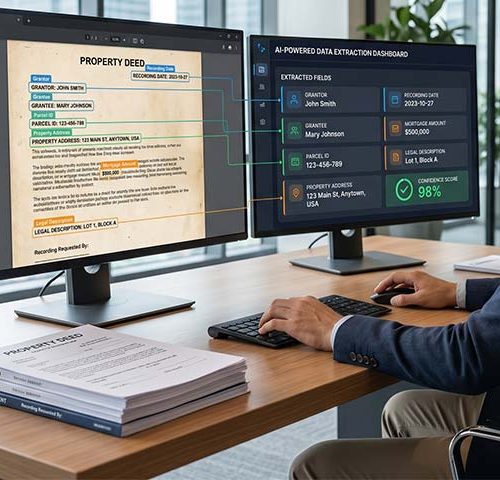
Property deed data extraction is not an OCR problem. It is a three-layer process such as OCR converts image to text, NLP identifies fields within that text, and schema normalization structures the fields for downstream use. OCR alone solves only the first layer. The gap between raw OCR output and reliable structured deed data is where most data platforms lose accuracy, throughput, and operating efficiency.
In practice, OCR-only workflows on deed documents deliver 70 to 80% field-level accuracy. Purpose-built AI extraction reaches 95%+ field-level accuracy, and 99%+ with human-in-the-loop validation. On a five million annual deed volume, the difference between 80% and 99% accuracy is 950,000 fewer field errors reaching downstream analytics products every year.
The industry has already taken note. According to Gartner’s 2025 Intelligent Document Processing report, 67% of enterprise document processing initiatives are now evaluating agentic AI approaches over traditional OCR-plus-rules stacks. This guide maps the operational difference between the two approaches and gives data operations leaders a structured framework for evaluating purpose-built deed data extractors.
Data operations leaders responsible for property data platform accuracy, throughput, and total processing cost can avoid systematic OCR-only failures and reach 99%+ field-level accuracy by doing the following:
Table of Content
When data operations teams first approach property deed data extraction, they often frame it as an OCR problem. The deed is a scanned document. OCR reads it. The data comes out. This framing is understandable. It is also wrong.
More than 100 million property instruments are filed annually across 3,100+ U.S. county recording jurisdictions. Each jurisdiction has its own formats, indexing conventions, and recording rules. For data platforms aggregating deed records at national scale, that fragmentation is not background context. It is the daily operating environment.
The industry has already taken note. According to Gartner’s 2025 Intelligent Document Processing report, 67% of enterprise document processing initiatives are now evaluating agentic AI approaches over traditional OCR-plus-rules stacks. The shift is driven by the accuracy limitations of OCR on complex, semi-structured documents.
OCR handles the character recognition layer. It converts an image into machine-readable text. It does not understand what that text means, where each field sits within a non-templated legal document, or how the same logical field appears across hundreds of structurally different county formats.
That gap, between raw OCR output and reliable structured deed data extraction, is where most data platforms lose accuracy, throughput, and operating efficiency.
Property document OCR technology has improved significantly over the past decade. Modern OCR engines achieve high character-level accuracy on clean, digitally recorded deed documents. For many data platforms, that accuracy metric is what gets evaluated at procurement, and it creates a false sense of confidence.
Here is the critical distinction. OCR operates at the character level. It converts image pixels into readable text, nothing more.
Property deed data extraction is a separate and harder problem. It requires three distinct layers:
OCR only solves the first one. A deed that is 99% character-accurate at the OCR layer can still produce incorrect grantor names, incomplete legal descriptions, and missing recording data. OCR has no understanding of what those characters mean or which fields they belong to.
In practice, OCR-only workflows on deed documents deliver 70 to 80% field-level accuracy. This is based on Hitech i2i’s analysis of document processing across 1,000+ U.S. county formats and document vintages spanning 20+ years (Hitech i2i, Platform Performance Data, 2024).
Purpose-built AI extraction handles all three layers. It reaches 95%+ field-level accuracy, and 99%+ with human-in-the-loop validation.
The cost of that gap compounds at scale. Gartner estimates that poor data quality costs the average organization $12.9 million annually. This accuracy gap is independently corroborated by IDP industry research. Next-generation AI document processing achieves 99%+ accuracy versus 60 to 80% with legacy OCR systems.
For data platforms, deed-level field errors accumulate silently through the pipeline. They surface as client data quality failures downstream, where they cost the most to fix.
Format variation across counties
A warranty deed from Harris County, Texas and a grant deed from Los Angeles County, California both contain the same logical fields. They present those fields in entirely different positions, formats, and label conventions.
OCR reads both accurately. Without AI trained on deed-specific layouts, the extraction logic cannot map either document’s content to a consistent output schema.
Legal description complexity
Metes-and-bounds descriptions, lot-and-block references, and Public Land Survey System (PLSS) notations each have distinct structural patterns. They appear embedded in narrative legal language, not in labelled form fields.
OCR captures the text. AI trained on real estate document language identifies it as a legal description and extracts it as a discrete field.
Historical document degradation
National property deed data requires ingesting historical records spanning 20 to 40 years. Older deeds (typewritten instruments, carbon copies, handwritten annotations) produce high OCR error rates on standard engines.
Real estate-specific OCR pre-trained on historical deed formats handles this content more reliably. It has been trained on it.
The table below maps where deed OCR extraction alone holds up and where purpose-built AI deed extraction is required. For data platforms processing multi-county feeds at scale, the gaps in the OCR column are not edge cases. They are the daily operating environment.
Independent analysis confirms the ceiling. Traditional OCR engines hit a ceiling of 90 to 93% field accuracy on diverse document streams. The number drops to 60 to 80% on complex layouts. The cause is structural, traditional OCR engines lack document understanding.
| Capability | OCR Only | AI-Powered Deed Data Extractor |
|---|---|---|
| Character recognition on clean digital deeds | Strong. High character-level accuracy on standard formats. Field-level accuracy typically 70 to 80% without AI extraction layer. | Strong. Same OCR foundation plus field-level validation. |
| Character recognition on historical / degraded scans | Inconsistent. Character error rates rise on older formats. Field-level accuracy drops further below 70% on degraded or handwritten documents. | Improved. Pre-trained on historical deed layouts. Field-level accuracy maintained at 95%+ with confidence-scored exception routing. |
| Field identification without fixed templates | Weak. Requires rule-based position mapping. | Strong. NLP identifies fields from context, not position. |
| Legal description extraction (metes and bounds) | Fails. No understanding of spatial legal language. | Reliable. Trained on all three legal description formats. |
| Multi-county schema normalization | Not included. Raw text output only. | Included. Normalized output schema across all counties. |
| Grantor / grantee entity type classification | Not included. | Included. Individual, LLC, trust, corporate, government. |
| Derived field generation | Not possible. | Supported. Calculated fields generated from extraction context. |
| Confidence scoring per field | Not included. | Included. Exception routing for low-confidence fields. |
| Deed type classification | Not included. | Included. Warranty, quitclaim, grant, trustee, sheriff, etc. |
| Trust deed data extraction | Partial. Captures text only. | Partial. Captures text only. |
| Processing cost at scale | Processing cost at scale | Higher per page. Significantly lower total cost including QA. |
A purpose-built deed data extractor is not a single technology. It is a pipeline of complementary capabilities working in sequence.
Understanding each stage helps data operations leaders evaluate vendors on the right criteria, not surface-level OCR accuracy claims.
The pipeline begins with ingestion. Deed documents arrive as scanned PDFs, e-recorded digital files, TIFF images, and photographs of physical instruments.
The OCR layer converts image content into machine-readable text. Real estate-specific OCR property records engines are pre-trained on deed-specific layouts, historical formats, notary stamps, and handwritten annotations that standard OCR engines misread.
This pre-training is the first point of differentiation. Generic OCR engines are optimized for clean, structured document types.
Property deed OCR must handle typewriter fonts from instruments recorded in the 1980s, degraded microfilm scans, and cursive handwriting on older recorded documents. That content falls outside the training distribution of standard tools.
Before field extraction begins, the system classifies the deed type. Each instrument type carries different field structures:
Accurate AI document classification ensures the right extraction logic is applied to each instrument type, not a generalized template that treats all deeds as structurally equivalent.
For platforms processing daily county recording feeds, classification must also handle borderline instruments. Corrective deeds, deed-in-lieu documents, and affidavits of heirship are deed-adjacent but structurally distinct.
Misclassification at this stage produces downstream field errors that are expensive to detect and correct at volume.
Once classified, natural language processing models extract individual data fields from the deed text. These models are trained on real estate document language.
They understand the semantic context of deed content. They do not rely on fixed keyword positions or template anchors.
A legal description beginning Lot 14, Block C, Desert View Estates, according to the plat recorded in Book 89, Page 34 is identified as a legal description because the model understands deed language. It does not find the label “Legal Description” printed above it.
This is the core difference between NLP-powered property deed data extraction and rule-based OCR parsing.
Every field extracted receives a confidence score, a numerical value reflecting the model’s certainty about that extraction. Fields below a calibrated threshold are routed to human review rather than passed downstream.
This is the quality control mechanism that makes straight-through processing viable at scale.
In a well-calibrated pipeline, 85 to 90% of deed records process without any human review. This is based on Hitech i2i’s analysis across 1,000+ county formats and 20+ million documents processed (Hitech i2i, Platform Performance Data, 2024).
The remaining 10 to 15% are typically older, handwritten, or degraded instruments. They receive targeted human-in-the-loop (HITL) reviews.
This is far more efficient than blanket manual QA. It is what enables deed processing AI to deliver cost reductions without sacrificing accuracy.
The final stage normalizes all extracted fields to a consistent output schema regardless of county of origin. Different counties use different formats for the same data:
All normalize to the same output field. This makes the output of AI data extraction for property records analytics-ready without additional transformation by the data engineering team.
The range of extractable fields varies by deed type and platform configuration. The table below covers the core fields captured from standard deed instruments.
It includes derived fields generated by the extraction pipeline rather than copied directly from document text.
| Field Category | Field | OCR Only | AI Extractor |
|---|---|---|---|
| Party Data | Grantor Name(s) | Text only. No entity parsing. | Full legal name + entity type classification |
| Party Data | Grantee Name(s) | Text only | Full legal name + entity type classification |
| Party Data | Grantor / Grantee Address | Inconsistent. Layout dependent | Extracted and normalized |
| Property Identity | Legal Description | Text block. Unstructured | Parsed by format type (metes / lot-block / PLSS) |
| Property Identity | Parcel / APN Number | Where labelled only | Extracted with county format validation |
| Property Identity | Property Address | Where stated. Often absent | Extracted or flagged as derivable |
| Transaction Data | Consideration / Sale Price | Where labelled only | Extracted including coded amounts |
| Transaction Data | Deed Type | Not classified | Classified warranty, quitclaim, grant, etc. |
| Transaction Data | Execution Date | Where labelled | Extracted and normalized |
| Recording Data | Recording Date | Where labelled | Extracted and normalized to standard format |
| Recording Data | Instrument / Doc Number | Where labelled | Extracted with county format awareness |
| Recording Data | Book and Page Reference | Where present | Extracted for pre-digital instruments |
| Derived Fields | Ownership Entity Type | Not available | Individual / LLC / trust / corporate / government |
| Derived Fields | Transfer Type Classification | Not available | Arms-length vs. non-arms-length signal |
| Trust Deed Fields | Trustee Name and Authority | Text only | Extracted with role identification |
| Trust Deed Fields | Beneficiary / Lender Name | Text only | Extracted with entity classification |
Trust deeds are a structurally distinct deed type that require extraction logic beyond standard conveyance instruments. A deed of trust is a three-party instrument:
Generic deed OCR tools do not model these field relationships. Purpose-built trust deed data extraction identifies all three parties with their respective roles.
It extracts the trustee’s authority reference to the original deed of trust. It captures the beneficiary or lender name with entity classification.
For data platforms building lien and financing datasets, this distinction between a conveyance deed and a trust deed at the extraction layer is the difference between reliable and unreliable downstream data.
The gap between OCR-only extraction and purpose-built AI deed processing is not theoretical. A leading U.S. real estate data aggregator faced specific, measurable processing constraints.
The aggregator was processing deeds, mortgages, assignments, and lien documents from 700+ counties across 40 U.S. states. They were managing over five million documents annually when processing constraints began to limit scalability.
The aggregator implemented an AI-powered intelligent document processing pipeline. The implementation covered four operational components:
The implementation also adopted PRIA-standards normalization. This ensures that extracted deed data aligns with the Property Records Industry Association’s data interchange standards. PRIA-standards alignment is a prerequisite for reliable multi-county data delivery on a national scale.
This outcome is representative of what property deed data extraction at scale can deliver. The key is treating OCR as one stage of a purpose-built pipeline rather than the complete solution.
The 10-percentage-point accuracy gain (from 90% to 99%) on a 5M document annual volume eliminates 500,000 field errors per year. Those errors would otherwise accumulate in downstream analytics products.
For data operations leaders, the choice between OCR-only and AI-powered deed extraction affects three metrics that flow directly to client data quality:
OCR-only workflows appear cheaper per page at procurement. They produce higher downstream costs through manual QA, error correction, and client data quality failures.
A 1% field error rate on a dataset of 5 million deed records produces 50,000 corrupted data points. For downstream analytics products (automated valuation models, lien verification, ownership history reports), those errors produce unreliable outputs.
ALTA’s 2025 analysis of title insurance claims found that nearly half of all reported losses on lender policies trace back to three categories such as fraud, forgery, and lien priority failures.
ALTA’s claims analysis does not attribute losses directly to extraction quality. Data operations leaders working across lien verification, ownership history, and fraud detection recognize that upstream deed data errors compound through every downstream layer.
Data accuracy is not an operational metric in isolation. It is a product quality metric with direct financial consequences.
For data engineers building ingestion pipelines, the extraction layer determines the complexity of everything that follows. A normalized, schema-consistent extraction output with confidence metadata reduces the transformation and enrichment logic downstream.
An inconsistent OCR output with no field labelling or confidence signals does the opposite. Every county becomes a custom normalization project.
The extraction layer determines the manual intervention load across the entire workflow.
PDFs, TIFFs, scans from county portals
Character-level recognition, no field structure
Operators read OCR output, copy fields into target schema
Heavy manual review — every document Field-level accuracy ceiling: 70–80%Blanket QA on full document volume
Headcount scales linearly with volumeEach county becomes a separate engineering project
Recurring data engineering workDelivered with downstream error rate
PDFs, TIFFs, scans from county portals
Pre-trained on deed layouts, handwriting, microfilm
Warranty / quitclaim / grant / trustee / sheriff / etc.
50+ fields per instrument, context-driven
Only low-confidence fields routed to human review
Unified output across all counties — no per-county work
Property deed data extraction is the process of identifying and capturing structured data fields from deed instruments. The captured fields include grantor and grantee names, legal descriptions, parcel numbers, recording dates, consideration amounts, and deed type classifications.
The output is a consistent, analytics-ready schema. AI-powered extraction goes beyond OCR to add field identification, normalization, confidence scoring, and derived field generation.
Deed OCR converts a scanned deed image into machine-readable text. It handles character recognition.
AI deed data extraction takes that text and identifies, classifies, and normalizes each data field within it. OCR alone produces a text block. AI extraction produces a structured dataset.
For multi-county processing at scale, OCR accuracy is a necessary starting point, not a sufficient endpoint.
A trust deed data extractor is an AI extraction model configured to handle the three-party structure of deed of trust instruments. It identifies and separates the borrower, trustee, and beneficiary roles.
It extracts the trustee’s authority reference. It captures the beneficiary or lender name with entity classification.
Standard deed OCR tools do not model these role relationships. They typically return all three parties as undifferentiated text.
Real estate-specific OCR models are pre-trained on historical deed formats. The training set covers typewriter fonts, carbon copies, handwritten annotations, and degraded microfilm scans.
For genuinely low-quality documents, confidence scoring flags individual fields below the accuracy threshold for human review. The system does not pass potentially incorrect data downstream.
This targeted HITL approach maintains accuracy without requiring manual review of every document in the batch.
Purpose-built platforms trained on national county data can cover 1,000+ U.S. county formats. They adapt to jurisdictional conventions and historical recording layouts.
Generic OCR tools and rule-based parsers typically cannot achieve this without significant custom configuration per jurisdiction. That approach does not scale across a national county footprint.
Training scope is a critical evaluation criterion when assessing any deed data extractor.
For mortgage and title workflows, AI extraction processes deed instruments as part of a broader document intelligence pipeline. The pipeline:
The extraction layer removes the manual preparation work. Downstream processes operate from structured data, not raw scans.
Ask vendors to demonstrate field-level accuracy. Specifically on legal description extraction and grantor/grantee entity classification.
Character recognition rates on clean documents are not the right test.
Any credible deed data extractor should process a representative sample of your county feed before you commit to integration.
Evaluate on the hardest 15% of your document mix, not the easiest 85%.
Ask how thresholds are calibrated. Ask what percentage of your document mix routes to human review. Ask how the platform handles systematic accuracy declines on specific county formats.
Platforms that cannot answer these questions clearly have not operationalized their quality control.
Extraction accuracy and schema normalization are distinct capabilities.
A platform that extracts accurately but delivers inconsistent output formats still creates significant transformation work for your engineering team on every county you add.
OCR-only workflows appear cheaper at the processing layer. Measure total cost including downstream QA headcount, error correction, and client data quality remediation.
For a documented example of what this calculation looks like in practice, see how leading data aggregators use Hitech i2i.
Most data platforms evaluate deed extraction vendors on the wrong criteria at the wrong time. A 15-minute demo on clean, pre-selected documents does not reveal real performance.
The framework below gives data operations leaders and data engineers a structured approach to running a meaningful evaluation before any procurement decision.
Pull a representative sample of 500 to 1,000 deed records from your actual production feed. The sample must include three document conditions:
The split should reflect your actual document mix. If 30% of your feed is pre-2000 historical records, 30% of your test set should be too.
Vendors who request a cleaner or smaller sample than your production reality are optimizing for the demo, not for your operating environment.
Identify the 10 to 15 fields that matter most to your downstream products. Score against those specifically.
The fields below are the highest-value test criteria for deed extraction. They are the hardest to extract reliably and the most damaging when wrong.
| Field | Why It Is the Critical Test | Pass Threshold |
|---|---|---|
| Grantor / Grantee Name | Entity parsing, not just text capture. Must distinguish individual, LLC, trust, corporate correctly. | 98%+ field-level accuracy |
| Legal Description | Tests NLP understanding of metes/bounds, lot-block, PLSS formats embedded in narrative text. | 95%+ complete extraction |
| Recording Date | Tests normalization across county format variations. | 99%+ normalized correctly |
| Instrument / Doc Number | Tests county format awareness. Format varies significantly across jurisdictions. | 99%+ extracted correctly |
| Deed Type Classification | Tests classification accuracy across all seven major deed types plus borderline instruments. | 97%+ correctly classified |
| Consideration Amount | Tests extraction of coded and non-standard amounts, not just labelled dollar figures. | 95%+ extracted correctly |
| Parcel / APN Number | Tests county-specific format recognition. APN format varies by state and county. | Tests county-specific format recognition. APN format varies by state and county. |
Before submitting your test set, manually verify the correct field values for a random subset of 50 to 100 documents. This is your ground truth.
Score the vendor’s output against it using field-level accuracy. Not character accuracy.
A field is correct only if the complete value is extracted and normalized correctly. Partial matches count as failures.
Calculate three metrics for each field:
A platform that extracts 99% of recording dates but formats them inconsistently across counties still creates downstream transformation work.
Ask the vendor to return confidence scores alongside their sample output. Then test two things.
First, whether low-confidence fields actually correlate with extraction errors. A well-calibrated model should flag its own mistakes.
Second, what percentage of your test set falls below the exception routing threshold. This is your projected HITL rate in production.
A projected HITL rate above 20% on a representative sample suggests the model is not well-calibrated for your document mix.
A projected rate below 5% on a sample that includes historical and complex documents suggests confidence thresholds are set too permissively. Errors are passing through undetected.
The target range for a well-calibrated platform on a mixed document feed is 10 to 15%.
Request that the vendor deliver sample output in your exact target schema. Not their default output format.
A platform that cannot map to your schema without significant custom configuration will require substantial engineering work at integration.
Evaluate schema flexibility as a first-class criterion alongside extraction accuracy.
For multi-county platforms, also check normalization consistency across the counties in your sample. Run a simple check:
For any field that should have a consistent format (recording date, APN, instrument number), count the number of distinct output formats across the county sample.
More than two or three distinct formats for the same logical field indicate incomplete normalization logic.
The table below summarizes the headline cost difference between OCR-only and AI extraction workflows for a platform processing 50,000 deed records per month.
It covers two common operating models such as onshore QA (U.S.-based staff) and offshore QA (India or Philippines-based BPO).
Figures are based on published industry benchmarks and are clearly labelled as illustrative. Your actual cost profile depends on monthly volume, document mix, county coverage, and QA operating model.
| Onshore QA (U.S.-based) | Offshore QA (India / Philippines) | |
|---|---|---|
| OCR-only est. total monthly cost | $34,500 to $70,000 | $12,500 to $39,500 |
| AI extraction est. total monthly cost | $9,500 to $19,500 | $7,750 to $16,250 |
| AI extraction cost advantage | 3 to 4x lower total cost | 1.5 to 2.5x lower total cost |
| Field-level accuracy (OCR-only) | 70 to 80% | 70 to 80% |
| Field-level accuracy (AI extraction) | 95%+ (99%+ with HITL) | 95%+ (99%+ with HITL) |
| Key driver of AI advantage | QA headcount cost elimination | Error volume reduction and client remediation savings |
One finding holds across both operating models. Offshore QA reduces the cost per document reviewed but does not reduce the number of documents that need reviewing.
That number is determined entirely by extraction accuracy. A platform generating 10,000 to 15,000 field errors per month requires the same QA volume whether the team is in Texas or Tamil Nadu.
The AI extraction advantage is therefore not diminished by offshore operations. It is expressed differently. Onshore platforms see it as headcount cost reduction. Offshore platforms see it as throughput capacity freed up for higher-value work and the elimination of client remediation costs that no offshore rate card resolves.
Get a customized cost model for your operation
The figures above are based on industry benchmarks for a standardized volume and document mix. Your actual numbers will differ based on your monthly deed volume, county footprint, historical document proportion, and QA operating model.
Request a customized property deed extraction cost analysis. The model will be built using your actual processing data.
Ready to evaluate AI extraction on your property documents?
See how Hitech i2i extracts, validates, and structures deed and property-record data across varied document types and county formats.
Explore AI Data ExtractionReal estate data platforms need an AI data extraction property deeds infrastructure that handles the full scope of U.S. deed complexity. Not a generic OCR tool configured to approximate it.
Hitech i2i is a purpose-built real estate document intelligence platform pre-trained on 150+ document types. The platform covers 1,000+ U.S. county formats and recording histories spanning 20 to 40 years.
To see how the pipeline performs on your specific deed mix, across your counties, document types, and historical vintages, request a free sample run. No configuration required before the sample.
Property deed data extraction is not an OCR problem. It is a field identification, schema normalization, and quality control problem. OCR is only the first step in solving it. Data platforms that evaluate deed extraction tooling on character accuracy metrics alone will consistently underestimate the downstream costs of OCR-only approaches. The cost shows up on multi-county, multi-decade deed data.
The customer story above makes this concrete. OCR-only workflows deliver 70 to 80% field-level accuracy on deed documents in practice. Moving to purpose-built AI extraction reaches 95%+ field-level accuracy before human validation, and 99%+ after.
On five million annual deed records, the difference between 80% and 99% field-level accuracy is 950,000 fewer field errors reaching downstream analytics products every year. For data operations teams building or rebuilding their deed processing pipelines, the extraction layer is not an infrastructure detail.
It is the foundational decision that determines the accuracy and cost profile of everything built on top of it.