
Intelligent document processing for real estate can classify, extract, validate, and structure property records at scale. A vendor’s published accuracy is normally measured on samples that the vendor selected. Performance on the buyer’s own documents, including mechanic’s liens, heirship affidavits, and degraded county scans, is the test that settles it.
A demo and a datasheet settle little of it. Each line below names the test that does, and the companion guide carries the protocol in full.
Table of Content
The accuracy figure on a vendor’s real estate document automation datasheet tells you how well the platform reads characters. It does not tell you whether you can rely on the decisions it supports, and that is the question this guide is built to answer.
A parcel number with one digit wrong passes character-level accuracy but identifies the wrong property. A misclassified document raises no error. A superseded value reaches closing unflagged. None of these shows up in a character-recognition rate.
You know your documents and what a bad record costs downstream. The five passes here test a vendor on your own mix, against ground truth you set, before you are committed to one.
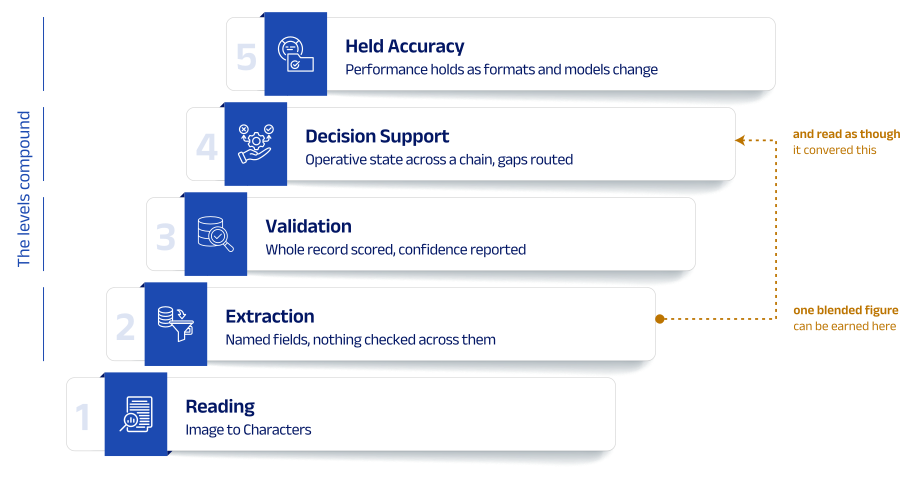
A single accuracy figure can be earned entirely at level 2 and quoted as though it covered level 4. So read down these five levels until one stops describing what you have. Make a vendor prove that first gap.
| Level | What the automation does | Where this guide tests it |
|---|---|---|
| 1. Reading | Converts the image to characters. OCR accuracy is counted character by character | Measure Real Performance, which separates OCR accuracy from field accuracy |
| 2. Extraction | Returns named fields, scored one field at a time, with nothing checked across them | Measure Real Performance, field-level accuracy by instrument category |
| 3. Validation | Scores the whole record, and reports a confidence that predicts its own error rate | Measure Real Performance for document-level accuracy, Verify Trustworthiness for calibration |
| 4. Decision support | Reconstructs the operative state across a chain of instruments, and routes what it cannot settle to a reviewer as a matter of governance rather than as a fallback | Verify Trustworthiness |
| 5. Held accuracy | Keeps that performance as county formats, document mixes and models change underneath it | Price the Real Cost, and the re-testing trigger that follows it |
The levels compound. A platform cannot reconstruct an operative state it never extracted, and a confidence score means nothing on a field the platform read wrong in the first place.
Which level is enough depends on what the records are for. A data platform shipping normalized feeds may weight level 4 operative-state reconstruction lower than a title operation sequencing liens, while still requiring level 5 production reliability just as strongly.
Read down until a level stops describing what you have
Weight errors by severity in the score itself. A lien release missed or misclassified leaves an encumbrance showing as open on a property where it was discharged. That error flows into a commitment, the title commitment reaches a buyer carrying a lien that was already released, the closing stalls until someone traces the discharge, and the curative cost, the delay, and the customer complaint land on the company that let it through. A misread document title does not carry that chain. Score the lien release heavier.
Then ask the vendor what the revalidation cadence is once the platform is running in production, and who owns recalibration if the scores drift.
Automated document processing puts up to eight operations between a scanned image and a row of structured data. Reading the text is the one a demo tends to show. The operations that decide whether the output is usable sit before and after extraction, and few of their failures announce themselves.
Extraction is one stage of eight
A demo shows the fourth box. The stages either side of it decide whether the output is usable.
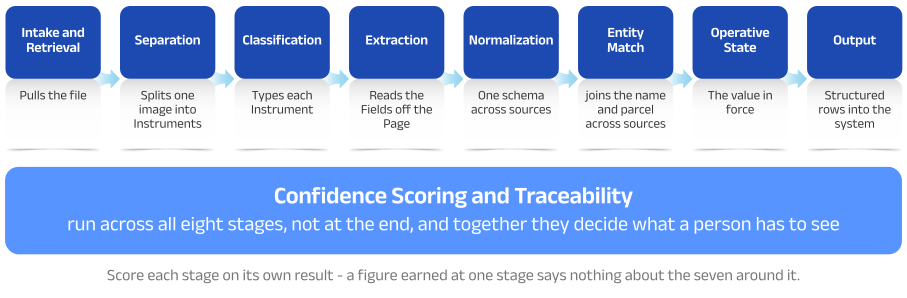
| Stage | What it does | How it can go wrong without flagging it |
|---|---|---|
| Intake and retrieval | Pulls documents from recorders, lender systems, data rooms, and title plants | A source counted as covered silently omits some instrument types |
| Separation | Splits a combined recording into separate instruments | Two instruments merge or one splits wrong, and every later stage works from wrong boundaries |
| Classification | Files each document as a type across jurisdictional naming variants | A mechanic’s lien filed as a general lien is a document classification error that sends every stage after it down the wrong path |
| Extraction | Reads names, legal descriptions, parcels, dates, amounts from context rather than position, using property deed data extraction methods | Degraded scans extract poorly but the output looks the same as clean records |
| Normalization | Resolves source formats into one schema through schema mapping and normalization | An unmappable value is forced into the nearest format unflagged |
| Entity and reference matching | Joins the same grantor, grantee, parcel, and term across variants | A missed join surfaces only when a downstream query returns incomplete |
| Operative-state reconstruction | Assembles current state across a chain of instruments and amendments | The value a later amendment superseded comes back with full confidence, because the earlier document read cleanly |
| Validation and routing | Scores confidence and routes low-confidence or high-stakes output to a reviewer | A low-confidence value moves downstream unflagged |
Confidence scoring and traceability run across all eight operations, and human-in-the-loop review closes the pipeline. The reviewer is the final approver.
Ask a vendor which stages are deterministic and which are probabilistic. Model-driven stages are the primary source of variance in AI document processing, but source changes, preprocessing shifts, and integration mappings can also alter output, so a revalidation plan covers more than the models alone.
Extraction cannot be scored until there are documents with known correct answers to score it against, and a review threshold cannot be judged until the error rate it has to catch is known. So the five passes run in order, each answering a question the one before it leaves open.
The companion guide, Running the Evaluation, carries each pass in full.
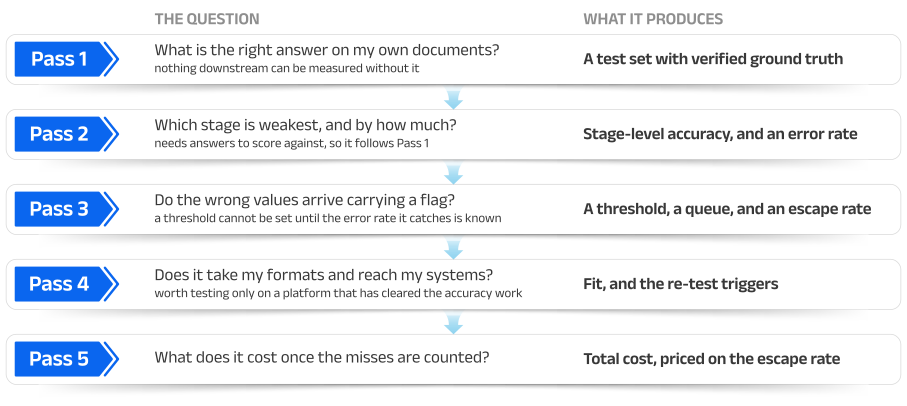
Which pass you weight heaviest depends on what you do with the documents. The passes themselves do not change, and none of them gets skipped.
| Segment | Heaviest weight | Key pass |
|---|---|---|
| Data platforms | Classification per instrument type, normalization consistency, document-level accuracy | Measure Real Performance |
| Title companies | Operative-state reconstruction, gap routing, turnaround under volume spikes | Verify Trustworthiness |
| MLS organizations | Cross-jurisdiction normalization, entity matching, compliance trail | Measure Real Performance |
| Lenders and settlement | Operative-state reconstruction, audit trail, regulatory compliance | Prove It Fits Your Operation |
Your product is the feed, so classification and normalization decide it. A misclassified instrument passes through as a wrong answer, and normalization failures break downstream records even when classification is correct. Inaccuracy cascades to incorrect valuations, legal disputes, and loss of credibility. Your data customers will want the source link behind any value they query.
Automated title document processing has to deliver the file examination-ready, with the chain of title sequenced and open encumbrances already surfaced. A gap reported as a complete chain is the failure you are testing for. Turnaround has to hold when volume spikes.
Validating and enriching listings against county record data extracted across jurisdictions is the job, and the data has to stay current as new instruments record. A record matching a listing to an incorrect public record produces wrong valuations and ownership, skewing search results, CMAs, and appraisals members rely on. Normalization across jurisdictions, entity matching between a listing and the record, and traceability from the enriched value back to the source instrument carry the weight.
These teams read records to decide whether an encumbrance is open or released, which terms control today. An incorrect lien state produces a flawed collateral view, and a wrong servicing or underwriting decision follows, with remediation or compliance exposure behind it. Weight operative-state reconstruction and the audit trail, confirm the output maps to MISMO or your own schema, and check compliance credentials regulators will ask about.
Take each of these from your own baseline before the trial starts, and read it again the same way afterwards.
Each depends on your own document mix, so a number quoted at you means little until measured.
Average handling time measures the processing work itself, not the calendar wait.
It covers every step from document input to validated output: ingestion, classification, extraction, normalization, validation, and delivery.
Manual processing of property records runs at tens of documents per analyst-day, which puts per-document handling time in the range of 15 to 25 minutes. An automated pipeline with human-in-the-loop validation processes thousands of documents per hour at the extraction stage, with validated output completing same-day for standard documents.
The AIIM 2025 survey of 600 enterprises found that reduced processing time is the benefit most organizations cite from intelligent document processing (50%), ahead of headcount reduction (30%).
Cost has four components.
Both of the last two push break-even past the month the sticker price implies
A per-document price leaves out the bottom block. Take the escape rate from Verify Trustworthiness, multiply by what one wrong record costs downstream, and add it to the other three.
A cheaper per-document price with a higher escape rate can cost more. IBM’s 2025 enterprise research documents the same dynamic: the cost of flawed data tends to land downstream rather than at the step where the error enters, and in its 2025 survey more than one in four organizations put annual losses from that pattern above five million dollars.
Screen before you score. Use this IDP vendor evaluation scorecard in two rounds. Use the first round of your RFP to eliminate vendors that fail non-negotiable requirements: required document and source coverage, source traceability, data governance, and security. Only shortlisted vendors proceed to evaluation on your own documents.
Score each shortlisted vendor on your own test set. 0 means does not meet. 1 means partially meets, remediation required. 2 means meets requirement on the buyer’s own documents. Data governance is pass or fail, and a critical failure there cannot be offset by strong scores elsewhere.
| Criterion | Vendor A | Vendor B | Vendor C |
|---|---|---|---|
| Ground truth / test-set quality | 0 / 1 / 2 | 0 / 1 / 2 | 0 / 1 / 2 |
| Field and record-level accuracy | 0 / 1 / 2 | 0 / 1 / 2 | 0 / 1 / 2 |
| Decision-support / operative-state reliability | 0 / 1 / 2 | 0 / 1 / 2 | 0 / 1 / 2 |
| Confidence score calibration and exception handling | 0 / 1 / 2 | 0 / 1 / 2 | 0 / 1 / 2 |
| Traceability, data lineage, and source evidence | 0 / 1 / 2 | 0 / 1 / 2 | 0 / 1 / 2 |
| Re-test / production reliability | 0 / 1 / 2 | 0 / 1 / 2 | 0 / 1 / 2 |
| Total cost of ownership | 0 / 1 / 2 | 0 / 1 / 2 | 0 / 1 / 2 |
| Average handling time | 0 / 1 / 2 | 0 / 1 / 2 | 0 / 1 / 2 |
| Data governance and security | Pass / Fail | Pass / Fail | Pass / Fail |
Weights shift by operating model. A title company, property data platform, MLS, and lender may score the same capabilities differently.
Evaluating document automation for a real estate data operation?
See how Hitech i2i applies classification, extraction, normalization, validation, and source-linked property intelligence across multi-county workflows.
Explore Real Estate Data PlatformsHitech i2i is a document intelligence platform pre-trained on 150-plus document types across more than 1,000 U.S. counties in all 50 states. Classification uses a separate model per instrument type, extraction reads fields from context, and each field carries its own confidence score. Uncertain output routes to a reviewer, who is the final approver.
Hitech i2i reports 99% field-level accuracy, with 80 to 90% of fields extracted without manual review and a 60 to 70% reduction in manual preparation effort. Buyers should validate that rate on their own document mix under Measure Real Performance, segmented by document type and condition. The effort reduction is measured against the baseline from price the real cost. The platform is SOC 2 Type II certified and GDPR-compliant, with on-premise and private-cloud options.
A US real estate data aggregator handling more than five million records a year from 700-plus counties across 40 states raised validated accuracy from about 90% to 99% and cut turnaround from five days to 48 hours, extracting 100-plus fields, normalizing to PRIA rules, and routing low-confidence fields to human review.
To run the five passes on your own document mix, request a sample evaluation.
Customer result:
See how a U.S. real estate data aggregator achieved 99% validated accuracy and reduced turnaround from five days to 48 hours. See the complete customer story →
Judging a document automation platform on an aggregate accuracy number does not predict production performance. A demo on clean documents does not either, and the per-document price on its own hides the cost that matters.
Run the five passes on your own mix, against ground truth you built and a bar you set first, and the weaknesses will show up before you sign. What you are testing is not whether the automation can read. It is whether you can trust the decisions it supports.
Read this as an evaluation framework rather than a product review. Operational figures attributed to Hitech i2i come from the company’s own published service data and are labeled as such; external figures are cited to their source.
Average handling time: Manual baseline of 15 to 25 minutes per document is derived from the published throughput comparison on the HitechDigital real estate document processing guide, which reports tens of documents per analyst-day for manual processing versus thousands of documents per hour for automated extraction. The AIIM 2025 IDP survey statistic (50% of 600 enterprises cite reduced processing time as the primary benefit) is sourced from the AIIM Market Momentum Index published via SER Group.
Hitech i2i is a participant in the market this guide evaluates, and the framework is written to be applied to any vendor, including Hitech i2i, on the reader’s own document mix and ground truth.