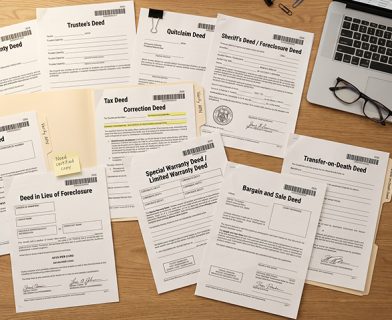
The operational companion sets out six evaluation steps, each with its test and pass bar, forming a title search automation evaluation checklist you can run against any vendor. The shape of the method is below.
This guide addresses six roles across the title chain. The first four carry the primary exposure; title plants and abstraction teams receive shorter treatment.
| If you are a | Start here |
|---|---|
| Title agency or settlement company | Abstraction and chain assembly, scored first. |
| Title examiner | Stage-level failure visibility, starting at Step 3. |
| Underwriter | Routing in Step 4, and the audit trail in Step 5. |
| Real estate law firm or attorney | Encumbrance detection, and the audit trail in Step 5. |
| Abstraction team | Abstraction, broken out by document condition. |
Table of Content
In Rassi v. Buckeye Title Agency, the examination found a HUD lien that shared a loan number with the first mortgage. The lien never reached the closing statement, and the buyers were billed for it after closing (Ohio Second District Court of Appeals, 2021).
The search was correct, and the failure came after it, between examination and the closing figures.
In 100 Investment Ltd. Partnership v. Columbia Town Center Title Co., two title companies missed that the sellers had already sold the same parcel four years earlier, and Maryland’s highest court held that they could be liable in negligence on a trial award of $191,510.88 (Maryland Court of Appeals, 2013).
One process caught the defect and lost it downstream. The other never caught it.
Automation can break at similar seams. A grantor cannot be matched to a prior grantee, an assignment is not on record, a data field is uncaught by scan. How the system reacts to those breaks is the first thing to evaluate.
Speed is not where the risk sits. Silent failures are. A finished chain gets reported when a gap was bridged without flagging it, or high confidence gets reported when a degraded scan was read against a model trained on clean records. When that risk is visible, and only when it is visible, the preparation work the automation takes off the examiner translates into capacity, meaning more files closed per examiner, at the same standard, without proportional hiring.
The difference between a system that surfaces those breaks and one that glosses over them is invisible in a demo on standard, digitized files. It appears when tested on files from manual-index counties, curative histories and estates.
The gap between an automated title search and a manual one is not speed. It is what each does with the file it cannot resolve.
More than 90% of title insurance companies are small businesses, according to ALTA’s 2026 complexity study. A firm of that size cannot run a six-month parallel trial. This guide takes the stages apart and shows how to test each one on your own files before you commit.
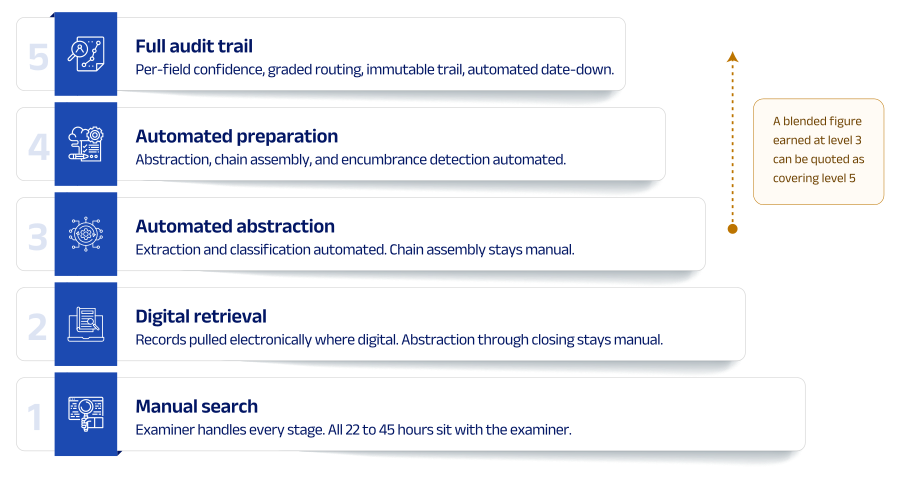
Most title operations sit somewhere between a fully manual search and a fully automated preparation pipeline. Read down until a level stops describing what you have.
| Level | What it describes |
|---|---|
| 1. Manual search | Examiner handles every stage. All 22 to 45 hours per transaction sit with the examiner. |
| 2. Digital retrieval | Records pulled electronically where digital, which ALTA puts at roughly 70% of county records. Manual retrieval for the rest. Abstraction through closing stays manual. |
| 3. Automated abstraction | Extraction and classification automated for digitized records. Examiner reviews flagged output and handles degraded and legacy instruments. Chain assembly stays manual. |
| 4. Automated preparation | Abstraction, chain assembly, and encumbrance detection automated. Confidence routing sends uncertain output to a validator. Examiner picks up at review. |
| 5. Preparation with full audit trail | All preparation stages automated with per-field confidence scoring, graded routing, immutable audit trail, and automated bring-to-date. Commitment-ready files delivered into the examiner’s system. The insure decision stays with the examiner. |
Related reading
U.S. property record types for what sits behind “degraded and legacy instruments” across jurisdictions.
ALTA’s 2026 complexity study finds that in over four out of five purchase closings the examiner works through 11 or more recorded documents, and that roughly one in five involves more than 50. Those files are where a vendor’s level claim meets reality, and where a blended accuracy figure earned on clean digitized records breaks down against degraded scans, microfilm and handwritten instruments.
Title search automation works by putting up to five operations between a set of recorded documents and a commitment-ready file. The stages run in sequence, each on its own technology.
| Stage | What it does | Where it can go wrong without flagging it |
|---|---|---|
| Retrieval | Pulls records from recorders, courts, bankruptcy, tax, UCC, and OFAC sources where those are digital. | A source listed as covered silently omits some instrument classes, and the non-digitized share of county records stays manual. |
| Abstraction (automated title abstraction) | Extracts structured fields from recorded documents, classifying each by instrument type. | A misclassified instrument can pass at high confidence; a degraded scan extracts poorly but the output looks the same as a clean record. |
| Chain assembly (chain of title automation) | Links sequential transfers of ownership from root of title to the current owner, resolving entity and legal-description variants. | A false merge or false split can return a chain that looks clean; a trust dead-end can be reported as complete. |
| Encumbrance detection (automated lien detection) | Pairs releases to mortgages, applies state-specific priority rules, catches non-obvious liens. | A partial release can read as full; a stranger’s judgment can attach; priority can break on instruments that do not rank by recording date. |
| Commitment preparation | Converts examination findings into a title commitment with Schedule B-I requirements and B-II exceptions. | A finding correct in examination can still never reach the written commitment. |
Related reference
OCR vs. AI: property deed data extraction covers what separates the two approaches at the abstraction stage.
Each of those silent failures carries a consequence beyond the stage it occurs in. A retrieval gap on a court source means the examiner works a file missing a judgment lien, and the gap surfaces only when the lender’s closer or the insured’s attorney finds it months later. By that point the closing has funded and the curative cost falls on your agency.
A false merge in chain assembly delivers a chain that reads as clean to the examiner, but a second buyer’s deed sits in the record. That failure traces back to fragmentation in the underlying property record, and the exposure is the 100 Investment scenario, where the title company carried the negligence judgment. An encumbrance that the automation paired to the wrong release shows a satisfied mortgage when the lien is still open; the commitment issues without the exception, and the claim follows.
Confidence scoring and an audit trail run across all five stages. At each stage the automation collects what it cannot resolve and routes only the flagged fields to a validator. The insure decision stays with the examiner. The operational companion carries the routing test and the audit-trail requirement in full.
The operational companion carries each step in full with its tests and pass bars. Here, the question each one answers.
The six-step framework does not change by segment. Where you sit in the chain decides which step carries the most weight, and the curative work that follows the search shifts with it. ALTA finds that nearly six in ten title professionals rank prior-mortgage release work as the most difficult curative task.
| Segment | Primary evaluation priority | Where automation adds the most value |
|---|---|---|
| Title agencies and settlement companies | Throughput across high-volume, mixed residential/commercial flow. | Abstraction and chain assembly at volume, freeing examiners for exceptions. |
| Title examiners | Stage-level failure visibility across the preparation pipeline. | Confidence routing that surfaces uncertain output at each stage, with the source page attached. |
| Underwriters | Audit-trail defensibility across every agency reporting in. | Compliance-defensible trails aggregated across the network. |
| Real estate law firms and attorneys | Defensibility and audit trail on every disclosed encumbrance. | Encumbrance detection with source-instrument citation, supporting closing opinions. |
| Title plants | Consistency of indexing and matching across decades of heterogeneous records. | Abstraction tuned to manual-index and legacy formats, not just digitized records. |
| Abstraction teams | Accuracy on the abstraction task, measurable on its own. | Abstraction as a discrete, benchmarkable stage rather than a black-box output. |
Price title search automation on total cost of ownership, not per-order rate. That means the per-page, per-order or subscription charge, plus implementation and training. Pin down what the pricing model counts as a billable order, because one file can bill several times over, across the automated pass, the human QA, an exception re-search, and the post-close date-down.
What matters to an executive buyer falls into four measurable outcomes:
Treat a flat turnaround quote as a red flag. The same standard residential purchase runs 1 to 2 days in a digitized metro county and 5 to 14 days in a manual rural one, as county-tier benchmarks show. A credible quote is scoped by county tier and file complexity, not given as a single day count. Ask which tier the quoted number describes. Confirm your data-export rights, because your files and audit trail must be portable, and an automation vendor that fails cannot be allowed to strand the record you carry the liability for.
Use this to compare title search automation providers on a single set of criteria rather than on each vendor’s own materials.
Screen first, then score. The binary round costs nothing and eliminates fast. The scored round costs examiner time and runs only against the shortlist. The tables below are a quick-read version; download the working scorecard to score real vendors against your own files.
A failure on any line ends the evaluation.
| Requirement | Vendor A | Vendor B | Vendor C |
|---|---|---|---|
| Can run on buyer’s own files (not only vendor samples) | |||
| Source-instrument audit trail on every output | |||
| Immutable log (not editable by admin) | |||
| SOC 2 Type II or equivalent | |||
| Data-export and portability rights |
A score of 0 means the vendor cannot demonstrate the capability on your files. 1 means it demonstrates on its own samples or on clean records only. 2 means it demonstrates on your files, segmented by instrument class and document condition.
| Criterion | Vendor A | Vendor B | Vendor C |
|---|---|---|---|
| Retrieval: source coverage across recorder, courts, tax, UCC, OFAC | |||
| Abstraction: field-level accuracy by instrument category | |||
| Chain assembly: flag-versus-bridge on known-variance files | |||
| Encumbrance detection: recall and precision, priority by state | |||
| Commitment hand-off: every flagged item lands, correctly typed | |||
| Routing: threshold routing with flagged-field-only review | |||
| Silent-gap handling: what the automation resolved without flagging it to the examiner | |||
| Confidence scoring: per-instrument-type, calibrated | |||
| Integration: delivers into existing title production system | |||
| Cost model: transparent per-order billing, scoped by complexity |
Run each surviving vendor through the scored round on your own files, weighted for your segment. The operational companion carries each criterion in full.
Run the test on paper first
The stage scorecard that accompanies this guide carries the weighting for your segment, a line for each of the six stages, and the two columns an accuracy figure never shows you, which are what the automation flagged as unsettled and what it bridged silently.
Download the Title Search Automation Evaluation ScorecardPut the evaluation framework to work on your title search workflow
See how Hitech i2i handles source retrieval, abstraction, chain assembly, encumbrance intelligence, validation, and examiner-ready title-search preparation.
Explore AI Title Search PreparationHitech i2i’s title search automation covers the preparation pipeline across data abstraction, chain assembly, lien and encumbrance intelligence, commitment-ready file preparation, and real-time SLA tracking.
Across more than 1,000 counties, clients report up to 2x file capacity and a 30-40% cut in rework. Commitment-ready files are supported in 1 to 4 hours, with automation handling 60% to 70% of routine preparation before the examiner reviews (Hitech i2i operational data).
One U.S. title insurance underwriter, among the top four nationally, needed supporting documents sourced across several plants and county recording offices, with strict turnaround expectations and 100% accuracy requirements. After Hitech i2i took on the preparation, 8-hour title search orders were delivered in under 5 hours, with automated extraction reaching above 85% accuracy, human validators catching the remainder to hold 100% output accuracy, and analyst productivity rising 30% (Hitech i2i customer story).
Hitech i2i is SOC 2 Type II certified and GDPR-compliant. It works within your existing workflow and delivers into the search platform you already run. Apply the same six-step framework and the same scorecard to Hitech i2i that you would to any vendor.
None of those figures is an independently audited benchmark. They are Hitech i2i’s own reported operational data. The file-test-set method in the evaluation steps is how you verify them against your own order mix before relying on them.
Whichever segment you are in, Hitech i2i will run a free sample on your own files, so you can score its output against the tests in this guide.
Customer result:
See how a leading U.S. title insurer increased analyst productivity by 30% while accelerating title-search preparation. See the complete customer story →
Every stage the automation runs prepares the file for the one decision it cannot make, which is whether the chain of title is clear enough to insure. That decision stays with the examiner, and a final bring-to-date update closes the file behind it.
Automation earns its price on the preparation work it takes off the examiner, checked against your own files and backed by an audit trail that holds up months later. Between two automation vendors, the one to buy is the one that leaves your examiners the fewest problems in the stages it took over.
A title search automation evaluation is only worth what the test set behind it is worth, so run any vendor against your own files before you commit. If your exposure sits in record-level property data rather than title production, the companion framework for evaluating real estate document automation applies the same method to that decision.
Hitech i2i publishes this guide as a vendor selling title search automation into the market it evaluates, and claims no exemption from its own framework. The six steps are offered against Hitech i2i’s own solution, run on your files, and every Hitech i2i figure in this guide is labeled self-reported operational data. The operational companion carries each step in full.
Industry benchmarks are drawn from ALTA’s 2026 study of 449 title professionals across 47 states and its 2024 report on title professional time and resources. Case references are taken from the published appellate opinions. No academic or peer-reviewed sources were used.