A title plant can look complete and still fail to give the results you need. A posting lag can hide a newly recorded lien from a lookup. A mis-parsed legal description can make a valid instrument invisible to a tract search. And a broken mortgage-release link can send an examiner back into manual reconstruction.
In plain language, a title plant is a privately assembled database of county property records, indexed by land description and by party name. Its purpose is to make sure that all recorded information bearing on a parcel’s title can be found in one place. A title plant is also called an abstract plant in some states, including Texas. Usually, title companies build, buy, or lease a title plant to reduce the workload on examiners, freeing them from the duty to manually rebuild a property’s history from public records.
Title plant quality depends on more than coverage alone. There are five operational dimensions that have to work together for a plant to reliably support production. This guide helps title plant leaders assess each plant against those dimensions, find where reliability fails, and decide where title plant modernization and automation can create the most value.
| Term | Definition |
|---|---|
| Title plant | A privately assembled database of county property records indexed by land description and by party name, so that what bears on a parcel’s title can be found in one place. |
| Abstract plant | The statutory term in Texas (Insurance Code § 2501.004); same object as a title plant. |
| Geographic index | The primary lookup structure, with every instrument indexed by legal description (section-township-range, lot-and-block, or metes-and-bounds). |
| Posting | The daily process of receiving new county recordings and indexing them into the plant. |
| Cross-reference threading | Linking related instruments (mortgage to release, assignment chain) through prior document numbers. |
| Five dimensions of quality | Coverage, currency, indexing accuracy, relationship integrity, accessibility. The measures that determine whether a plant supports production at scale. |
Table of Content
Every title search starts with one question. Which documents touch this parcel?
County name indexes provide that answer by party name. A title plant provides better identification with a geographic index, reorganizing public records around the land itself.
As county records become more digitized and shared plant arrangements expand access, the more important question is whether the plant available to your operation is reliable enough to support production. Five dimensions determine that reliability, from coverage depth and posting currency through indexing accuracy, relationship integrity, and accessibility.
Here, we set out an operating reference for title plant leaders and operators. We also show how modernization, from digitization and API connectivity to automation and AI, is changing the way title plants are built, maintained, and integrated into production workflows.
County recorder offices organize their public records using grantor/grantee name indexes. To trace a chain of title, you start with the current owner’s name, find their acquisition deed, and then work backward through each prior grantor. Every link depends on name accuracy.
Name variations, misspellings, hyphenated surnames, trust entities, and common names all introduce gaps. Those gaps compound across decades of records.
A single typo on a 1987 deed can make an entire ownership link invisible to a searcher working the name index in 2026.
A title plant flips that. Think of a warehouse that files inventory by bin location instead of supplier name. It’s an entirely different approach. You can misspell the supplier on the invoice and can still find the goods, because the bin number does not change.
Similarly, in a title plant, each recorded instrument is indexed by legal description so that everything touching a given parcel sits in one place in chronological order. You search the tract index and find every deed, mortgage, lien, and easement tied to that parcel, regardless of who transacted or how their name was spelled.
The plant also carries a secondary name index for instruments that lack a legal description, including judgments, powers of attorney, federal tax liens, and certain affidavits. Between them, the tract index catches everything tied to the land and the name index catches everything tied to the parties.
County Name Index vs. Title Plant Geographic Index
Name Index Search
Typo: “Johnsen” vs “Johnson”Name mismatch breaks the chain
Each link depends on name accuracy
Title Plant Search
Tract Index: Lot 7, Block 3All instruments indexed to this parcel
Search by parcel, not by name
Name typos cannot break the chain
Data from an ALTA webinar (December 2014) reported by the Iowa Land Title Association quantifies the difference. A full title search averages 119 minutes through online county records but only 41 minutes through a plant search. Even a current-owner lookup drops from 31 minutes to under 15. Although the benchmark predates today’s digital search and automation tools, it illustrates the efficiency advantage that geographic indexing provides.
Related reading
For current ranges by access method, county tier, and loan type, see our title search turnaround time benchmarks.
And the geographic arrangement carries regulatory weight. Texas Insurance Code § 2501.004 requires an abstract plant to be geographically arranged as one of three statutory requirements it must meet.
Illustrative Scenario: When the Name Index Fails
A title examiner searches for liens against “Katherine O’Brien-Martinez” across three decades of county records. The county index lists filings under “Katherine O’Brien,” “K. Martinez,” “Katherine O’Brien Martinez,” and “O’Brien-Martinez, K.”
Four variations, each in a different alphabetical position in the name index. The examiner traces two but misses a 2004 mechanic’s lien filed under a fifth variation. A geographic index retrieves all five instruments together, by parcel, because the instrument is indexed to the land, not to the party’s name.
Building a title plant starts with acquiring county property records. Sources include the county recorder, tax assessor, courts, and existing title files.
Each recorded instrument goes through classification, data extraction, and abstraction. The indexer determines the document type, pulls structured fields (party names, property identifiers, transaction dates, amounts), and standardizes the data for database entry. Once extracted, the data gets indexed by legal description to create the geographic index, plus a name-based lookup path for party-only records.
For a new plant, this means processing years of historical recordings into a searchable database. That takes time. So many title companies shortcut the build by purchasing an existing plant or leasing access to one maintained by another company.
A title plant supports two parallel operating workflows. The first keeps the plant current through ingesting recordings, classifying documents, indexing legal descriptions, validating exceptions, and posting records. The second consumes the plant through searching by parcel or party, retrieving related instruments, reviewing relationships, and preparing information for examination. Modernization should improve both workflows. Document ingestion speed is only part of that.
Posting keeps the plant current. For each new instrument, an indexer reads it, determines the document type, parses the legal description, identifies the grantors and grantees, and indexes the document to the correct parcel. Related instruments get threaded through prior document numbers so a mortgage connects to its eventual release. Each recording within the plant’s defined coverage goes through this cycle.
Of all the steps in posting, legal description parsing is where indexer skill shows. The legal description is the bridge between a recorded instrument and the tract index. Get it wrong and the document is invisible to anyone searching that parcel.
The description does not go into the computer as written on the document. It has to be analyzed, restructured, and entered in the format the database system requires.
Sectional descriptions, platted descriptions, and metes-and-bounds descriptions each follow different rules. And the indexer must recognize which type they are reading and where errors may exist in how the drafter described the parcel.
And ambiguity compounds when parcels split, combine, or carry multiple legal descriptions on a single instrument. A parent parcel subdivided into child lots requires the indexer to map each child lot back to the parent tract so that a search on either returns the relevant history.
Multi-legal documents, such as a single mortgage covering three parcels in two subdivisions, must be indexed to every parcel they touch. Because normalization rules vary by county, an indexer working across jurisdictions must adapt to each convention without carrying assumptions from one county into another.
Searching is what the plant exists for. When a title order comes in, you search the geographic index by parcel and pull every instrument tied to that tract in chronological order. From there, the examiner traces the chain of title forward, checks for open liens, unreleased mortgages, easements, and judgments against parties in the chain. With a properly maintained geographic index, the examiner does not have to reconstruct the chain one owner at a time.
Core instruments: Warranty deeds, quitclaim deeds, special warranty deeds, mortgages and deeds of trust, assignments and releases, mechanic’s liens, tax liens, judgment liens, easements, and lis pendens notices.
Supporting records fill gaps that core instruments alone would leave, including probate records and divorce decrees, plat maps and survey references, powers of attorney, and tax sale certificates.
The geographic index is the primary lookup structure, and the name index provides an alternative path. Document-type classification adds a third layer, letting you filter a tract’s history by instrument category.
Four Indexing Layers in a Title Plant
Title Plant Indexing Architecture
Each layer adds a different retrieval path — geographic catches the parcel,
name catches the parties, type filters the history, threading connects the chain.
Cross-reference threading adds a fourth. A mortgage and its corresponding release are linked through prior document numbers, and an assignment chain is threaded instrument by instrument. This threading lets you verify that a lien was released or that an assignment reached the correct party without manually hunting through chronological records.
Illustrative Scenario: Relationship Threading Across Time
Consider a mortgage recorded in 2009, assigned in 2012, reassigned in 2015, and released in 2021. A document repository can return all four instruments.
A well-maintained plant preserves the relationship among them, connecting the release to the correct obligation through its prior document number and linking each assignment in sequence.
Without that threading, the examiner must reconstruct the chain manually, matching recording numbers, dates, and party names across four separate instruments to confirm the release closes the right mortgage.
Not all title plants serve the same market. Scale varies widely.
Local plants cover a single county and serve one office or a small group of title companies. They offer deep local familiarity but limited geographic reach.
Regional plants aggregate multiple counties within a state. They support title operations that write policies across a wider area. These plants require standardized indexing rules that accommodate county-to-county variations in recording practices and legal description formats.
Shared and leased plants separate ownership from access. Under Texas Insurance Code § 2501.004, joint abstract plant operations are contemplated. California Insurance Code § 12389 treats an owner’s participation in a jointly used plant system as keeping the plant currently maintained for asset-valuation purposes, provided the owner holds a contractual right to receive a copy of the title record data. In practice, many title companies lease access rather than building and maintaining their own plant.
Multi-state operations add another layer of complexity, because indexing rules, legal description conventions, document types, and regulatory requirements vary by jurisdiction. A plant operator serving companies in Texas, Florida, and California faces three different regulatory models for the same operational asset.
Building, buying, and leasing a plant differ in time, cost, control, and data ownership.
| Option | Time to production | Upfront cost | Ongoing cost | Control over quality | Data ownership |
|---|---|---|---|---|---|
| Build | Typically longest; years of records to acquire and post | Often highest; staff, systems, records | Posting, audits, upkeep | Full, from the first posting | Owned or controlled by the operator |
| Buy | Usually shorter; records already in place | Driven by the purchase price | Posting, audits, upkeep | Full after purchase; inherited errors persist until audited | Depends on acquisition rights and underlying licenses |
| Lease | Often shortest; access starts at contract | Usually lower | Recurring access fees | Limited to provider upkeep | Defined by contract |
How far back a plant reaches determines what it can support. No single national standard exists. Instead, historical depth varies by jurisdiction, plant operator, and operating purpose.
In Texas, the statutory floor is January 1, 1979, under § 2501.004. But one plant provider, DataTrace, reports Austin-area plants carrying at least 67 years of geographically indexed history, some reaching 110 years, and long-established plants in mature markets dating back nearly 150 years.
Separately, DataTrace reports that its digital title plants across eight Florida jurisdictions now offer three decades of searchable, geographically indexed depth. Sovereignty searches in Texas may trace ownership all the way to the original land grant from Spain, Mexico, or the Republic of Texas.
The distinction matters operationally. Statutory minimum, operational search period, and actual plant depth are three different measures. Meeting the statutory floor is one thing. Having the depth required for the search and underwriting requirements of the market you serve is another.
Two plant types serve different depth needs. A daily plant is posted with the county’s new recordings on a daily cycle.
A closed-file plant (also called a starter plant) is built from prior title commitments and binders, capturing completed research instead of indexing raw county recordings. Many title operations use both, running the daily plant for current coverage and drawing on closed files for historical depth.
The same object, an organized private copy of county records, is treated differently depending on the state.
| State | What is regulated | Statutory object |
|---|---|---|
| Texas | Capability: you must have a plant meeting three statutory requirements | Abstract plant (Insurance Code § 2501.004) |
| Florida | Process: you must perform a reasonable search and preserve the evidence | Determination of insurability (§ 627.7845) |
| California | Asset: how a plant may be carried and valued on the balance sheet | Title plant as asset (Insurance Code § 12389) |
Texas requires geographic arrangement, coverage back to at least 1979 that is kept current, and adequacy for insuring titles. Florida requires a defensible search process and evidence preserved for seven years, producible to the regulator on demand, without mandating a specific plant. California treats the plant as a depreciable balance-sheet asset. If a plant is not currently maintained, its regulatory asset value drops by one-tenth for each year it sits idle. Texas, Florida, and California illustrate three different regulatory approaches; requirements and practices vary across other states.
These jurisdictional differences carry real consequences for title plant design, because recording requirements, document formats, and legal description conventions vary state to state and county to county.
A title plant can exist and still fail its users. So what separates a working plant from a failing one? Five operational dimensions determine whether a plant actually supports production at scale.
Five Dimensions of Title Plant Quality
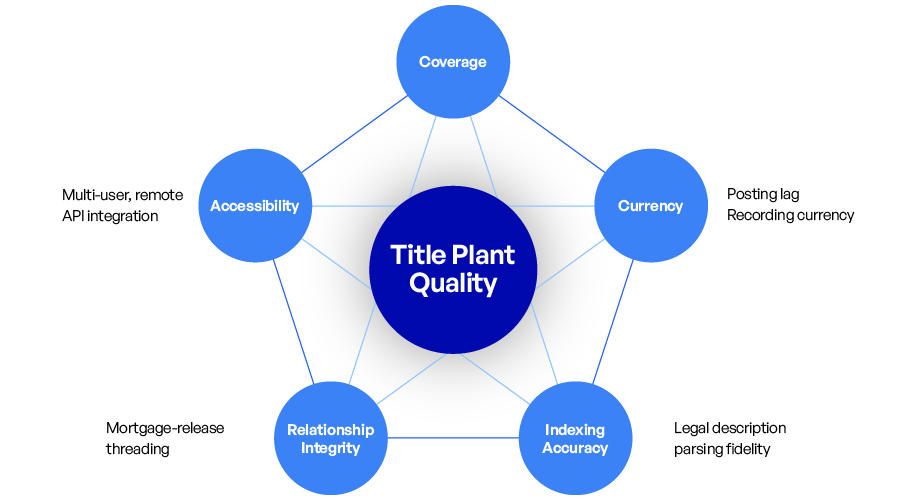
Coverage: How many counties does the plant serve, and how far back does the historical record reach? A plant covering 200 counties back to 1979 serves a different operation than one covering 12 counties back to 2005. When there are coverage gaps, examiners fall back to manual county searches for anything outside the plant’s range. Coverage means geography, historical depth, instrument types, source completeness, and image availability.
Currency: How many days behind the county recorder is the plant? A plant that posts same-day stays current with new recordings. A plant running five days behind misses recent deeds, liens, and releases, and searches against it return incomplete results. Posting currency is often one of the first dimensions to show stress when recording volumes increase. Posting lag should be measured by county or jurisdiction as well as an overall average.
Indexing Accuracy: How reliably are instruments indexed to the correct parcel? Accuracy depends on legal description parsing, entity matching, document-type determination, and the indexer’s ability to catch errors in the source document itself. And accumulated keying errors, entity mismatches, and broken legal descriptions corrupt the index over time. Accuracy shows in end-state correctness and also in first-pass quality, rework, and exception trends.
Relationship Integrity: Are related instruments threaded? A mortgage and its release should be linked, and an assignment chain should be traceable instrument by instrument.
Pulling structured data from a document is one operation. Connecting that document to the mortgage it releases or the assignment chain it extends is a harder one. Without threading, an examiner must manually reconstruct relationships across chronological records. That is the same problem the plant was built to solve. Unresolved threading exceptions can be tracked as an operating metric as well as a quality concept.
Accessibility: Can multiple examiners search simultaneously? Is the plant available remotely? Does it expose structured data through an API for production platform integration? A single-user, office-bound plant creates a throughput bottleneck even if its data is perfectly accurate. Remote and API access also affect examiner productivity and the percentage of searches that need manual workarounds.
These five dimensions interact. If a plant has broad coverage but poor currency, examiners get a false sense of completeness. If it has high indexing accuracy but no relationship integrity, they are stuck tracing relationships manually. So assessing a plant means measuring all five, not the ones easiest to count.
With the industry adopting AI for classification, extraction, and search preparation, these quality dimensions grow more critical.
A plant with accumulated indexing errors and broken chains gives automation unreliable inputs. A data audit finds those errors, re-indexing corrects them, repaired release links restore broken chains, and human review catches low-confidence results once the AI layer runs. Plant quality is the precondition for AI readiness.
Seven measures, reviewed weekly or monthly, show whether the five dimensions are holding.
| Metric | What to track | What deterioration may indicate |
|---|---|---|
| Posting lag | Hours or days between county recording and plant availability, tracked by jurisdiction. | Posting is not keeping pace with recordings, so searches in that county miss recent instruments. |
| Backlog aging | Unposted instruments by age bucket, highlighting counties or queues creating current-search risk. | Indexing capacity may be below recording volume or a queue may be stuck, so searches miss unposted instruments longer. |
| Indexing accuracy | Accuracy of parcel assignment, legal-description parsing, document classification, and key indexed fields. | Parsing or classification is failing on some instrument types; errors reach examiners as missed or misfiled documents. |
| Exception rate | Percentage of incoming instruments requiring manual review, escalation, or correction before posting. | Incoming documents are harder to classify, or rules and thresholds need retuning. |
| Relationship integrity | Unresolved mortgage-release, assignment-chain, or related-instrument linking exceptions. | Threading is falling behind, so examiners rebuild mortgage-release and assignment chains by hand. |
| Examiner fallback rate | Percentage of searches requiring external county/public-record research because plant data is incomplete. | Coverage or currency gaps are sending examiners to county records. |
| Throughput | Instruments processed per day or per indexer, viewed alongside quality and backlog metrics. | Falling output with rising backlog points to a capacity limit; rising output with falling accuracy points to haste. |
Building a title plant is a capital investment. Keeping a plant accurate is a continuing operating cost for an owner, whether the plant was built or bought.
County recorder offices file new instruments daily, and posting backlogs accumulate when new recordings outpace indexing capacity. Market swings make it worse. During a refinancing surge, daily instrument counts can double while the indexing team stays the same size. So every day the plant falls behind is a day when searches miss recent recordings, and the gap between the plant and the public record widens.
Title plant indexing is not simple data entry. An indexer must analyze legal descriptions across formats (sectional, platted, metes and bounds) and restructure them for the database.
Each format has its own rules. Beyond that, indexers must apply name rules that account for hyphenated surnames, trust entities, and naming conventions that vary by region, and determine document types by reading the full instrument rather than relying on the cover page alone.
When a legal description is entered incorrectly, the document will not surface in a parcel search. A missed lien can result in a claim against the title insurer. And these errors often go undetected until a search fails or a claim is filed.
Keying mistakes, name-spelling inconsistencies, and mis-parsed legal descriptions accumulate in the index without triggering any visible alert. Plant operators must periodically audit existing records against source documents, correct indexing errors, standardize name variations, and reconcile broken chain links. Without regular data hygiene, the plant’s reliability erodes even when new postings are handled well.
Related reading
Fragmented source records make the problem worse, as our guide on real estate data quality and property record fragmentation explains.
| Failure Mode | What Breaks | What the Examiner Experiences | Dimension |
|---|---|---|---|
| Posting lag | The plant falls days or weeks behind the county recorder | Recent transactions are invisible to searchers | Currency |
| Legal description mis-parsing | An instrument is indexed to the wrong parcel | Documents are missing from parcel searches | Indexing Accuracy |
| Broken threading | A mortgage is not linked to its release; an assignment chain has a gap | Examiners must manually reconstruct relationships across chronological records | Relationship Integrity |
| Coverage gaps | Missing instrument types, missing counties, or insufficient historical depth | Examiners fall back to the county recorder’s office for anything the plant doesn’t cover | Coverage |
| Entity mismatches | Same party, multiple spellings | Duplicate records or orphan records that should be connected | Indexing Accuracy |
Each failure mode produces the same downstream result. An examiner either misses something or has to work around the plant, and either one defeats the reason the plant exists.
Title plants have evolved through four stages.
| Stage | Characteristics | What changes |
|---|---|---|
| Manual | Paper or microfilm storage, physical pull retrieval, single-office access | Baseline: everything depends on physical proximity and filing accuracy |
| Digitized | Searchable database, software query, remote multi-user access, direct data entry | Search speed, simultaneous access, geographic reach |
| Connected | API-exposed data, production platform integration, distributed team access | Automation of search requests, structured data delivery, scalable throughput |
| Intelligent | AI classification, confidence-scored extraction, automated posting with human-in-the-loop validation | Volume handling without proportional staffing, consistency in indexing, real-time quality flags |
Automated Ingestion at Scale
A top four U.S. title insurance underwriter whose analysts searched multiple title plants and county record systems across Georgia and Texas deployed automated ingestion with field-level extraction and confidence-driven routing to human validators, the Intelligent stage in practice. The result was a 30% increase in analyst productivity.
Orders that previously required eight hours were delivered in under five, with critical field accuracy maintained through human-in-the-loop validation.
Title plant operations can sit at very different points on this maturity curve. Digitization solves the physical-access problem.
API connectivity integrates plant data into production workflows. AI-assisted processing adds automated document classification, confidence-scored data extraction, and exception routing while retaining human review for complex or uncertain instruments. The maturity model is therefore less about technology age and more about how effectively plant data can be maintained, connected, and used in production.
To find your plant’s stage, check which of these four descriptions matches how your team works today.
These stages also change the work of the people who run the plant.
As automation expands, the indexer role can shift from manually processing every routine instrument toward validating exceptions, resolving ambiguous legal descriptions, repairing relationships, and handling jurisdiction-specific complexity. Human review therefore becomes more targeted and stays important.
The title plant started as a physical warehouse of paper records organized by location. Digital conversion turned it into a searchable database. API integration made it a data service. The next shift is toward a plant that understands relationships between instruments, not just their locations.
Industry-level standardization is accelerating this shift. MISMO and ALTA have published dataset standards for title and settlement information, supporting broader adoption of structured, interoperable title data. These datasets establish common data definitions for moving title information between systems but do not themselves constitute a universal title-plant schema.
The industry has made substantial progress in aggregating property records. The next challenge is making that data more structured, connected, portable, and useful inside production workflows.
As relationship-aware systems mature, they could increasingly identify missing mortgage-release relationships, incomplete assignment chains, conflicting parcel references, and other conditions requiring examiner review. The objective is not to replace title judgment. It is to move more of the document reconstruction, relationship matching, and exception identification upstream before examination begins.
For plant operators, the practical question is which modernization step comes next. It could be digitizing legacy records, improving data quality, connecting plant data through APIs, strengthening relationship threading, or introducing automation. The answer depends on where the plant sits on the maturity curve today.
Related reading
For teams weighing the automation step, our buyer’s framework explains how to evaluate title search automation.
Twelve questions for assessing your title plant’s operational readiness, grouped by the five dimensions.
1. How far back does your historical coverage reach in each county you serve?
2. What is the posting lag between your plant and the county recorder?
3. What is your indexer-to-recording volume ratio, and how does it hold during refinancing surges?
4. How do you handle recording volume spikes (proportional staffing increase, overtime, or automated classification)?
5. What percentage of incoming instruments require manual legal description parsing?
6. When was your last audit of existing records against source documents?
7. What is your process for handling low-confidence document classifications?
8. Do you have a documented quality control process for new postings that includes spot-check audits?
9. Are name variations standardized across the entire database, or do legacy records carry unstandardized entries?
10. Are all mortgage-release pairs threaded through prior document numbers?
11. Can multiple examiners search the plant simultaneously from different locations?
12. Can downstream systems consume plant records programmatically, or does every query require a manual session?
A “no” or “I don’t know” on any of these questions points to a gap in that dimension of plant quality that needs operational attention.
In Texas, a title plant (called an “abstract plant” in statute) is a regulatory requirement. Under § 2501.004 of the Texas Insurance Code, the Texas Department of Insurance sets the standards for an abstract plant, which must “be geographically arranged,” “cover a period beginning not later than January 1, 1979, and be kept current,” and “be adequate for use in insuring titles, as determined by the department.”
A direct search uses county grantor/grantee indexes to trace ownership and encumbrances by party name. A title plant search uses a geographic index organized by parcel, pulling all recorded instruments for a tract regardless of party names. The plant approach reduces name-dependency failures and returns results faster on parcels with long recording histories.
Yes. Online county records improve access, but they do not provide geographic organization, normalized historical coverage, relationship threading, or production-ready retrieval. A plant indexes each instrument to its parcel and links related instruments, so a search of the plant returns the recorded instruments for a tract in chronological order, whether the county records are online or not.
Yes. Leasing is common in practice, and both California and Texas statutes contemplate shared or jointly operated plant arrangements. California § 12389 treats an owner’s participation in a jointly used plant, with a contractual right to a copy of the title record data, as keeping the plant currently maintained for asset-valuation purposes.
There is no single national standard for title-plant depth. Historical coverage varies by jurisdiction, underwriting requirements, search purpose, and the plant itself. Texas statute establishes a floor of January 1, 1979, while mature commercial plants in some markets contain substantially deeper histories. How far back the law requires, how far back the market searches, and how far back the plant actually reaches are three different measures worth evaluating separately.
AI can automate repetitive, high-volume tasks in plant maintenance, including document classification and structured field extraction. Machine learning can assign confidence scores, with low-confidence results routed to human validators before entering the index. The same pipeline applies to backfile digitization, where decades of historical records need conversion into searchable format.
Hitech i2i supports title plant operators across the life of a plant, from building a new plant and converting a legacy one to enriching and maintaining an existing one. It can also consolidate records from multiple counties or acquired plants into one structure, and audit an existing plant for indexing completeness, classification accuracy, and coverage gaps. Its AI title plant indexing and automation service supports each of the five quality dimensions in this guide, as the table shows.
| Plant dimension | How Hitech i2i supports it |
|---|---|
| Coverage | Turns historical backfiles into structured plant data, whether for a new county build, a legacy conversion, or filling gaps. |
| Currency | Indexes new recordings the same day they arrive and delivers incremental plant updates on the operator’s schedule. |
| Indexing accuracy | Standardizes names, legal descriptions, parcel details, and recording data, and routes unclear documents to human review. |
| Relationship integrity | Surfaces related instruments and flags uncertain relationships for examiner review. |
| Accessibility | Posts validated records into the operator’s existing plant by API, SFTP, delta file, or custom connector. |
The plant stays the operator’s own. Hitech i2i classifies and extracts the data and posts search-ready records into the plant, while final title and underwriting decisions remain with qualified title professionals. Each indexed field is traceable to the source instrument it came from, with its page and location, a confidence score, and the business rules applied, so an automated decision can be reviewed.
Scaling County Coverage for a Property Data Provider
A U.S. property data provider expanded county record processing from 2 to 345 counties in six weeks using an ingest-classify-extract pipeline with dual quality checks. Throughput reached 8,000 documents per day, delivering 100% on priority data points and 95% on all remaining extracted fields per SLA.
How fast examiners can search, how reliably they can trace a chain of title, and how well an operation absorbs changing volume all depend on the quality of the title plant beneath the workflow.
Geographic indexing solves many of the weaknesses of name-based searching, but indexing alone is not enough. Coverage, currency, indexing accuracy, relationship integrity, and accessibility determine whether the plant actually supports production.
As title operations become more connected and automated, the title plant is evolving from a repository of historical records into a structured data foundation for title search preparation and examination workflows. The stronger that foundation is, the more effectively automation can build on top of it, and the more time examiners can spend on title judgment rather than reconstructing information.
This guide combines publicly available industry and statutory sources with Hitech i2i’s operational experience supporting title plant indexing and title search preparation across 1,000+ U.S. county formats. Statutory requirements are summarized from the legislature-hosted text of each statute. Industry figures are attributed to the publisher that reported them.